 Tobin
Explore
Jump in anywhere, in any order. Every activity reshuffles each time you play, so there's always something new. You earn records for every right answer.
Big questions to wonder about
By the end of this unit, you'll be able to answer every one of these.
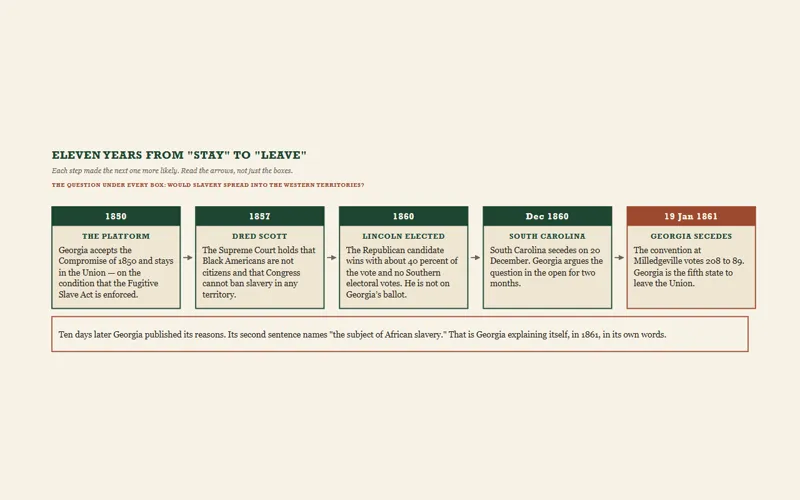
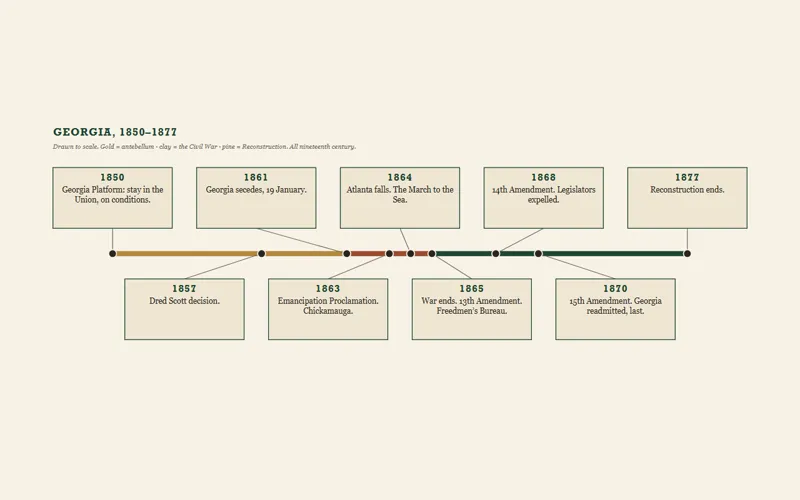
In 1850 Georgia voted to stay in the Union. In 1861 it voted to leave. What changed in those eleven years?
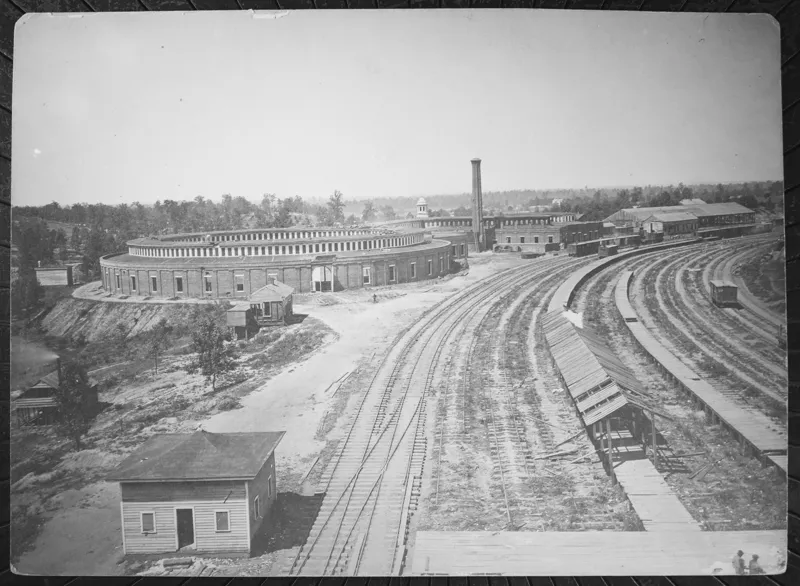
Why would a general in 1864 want a railroad yard more than a fort?Photo: National Archives
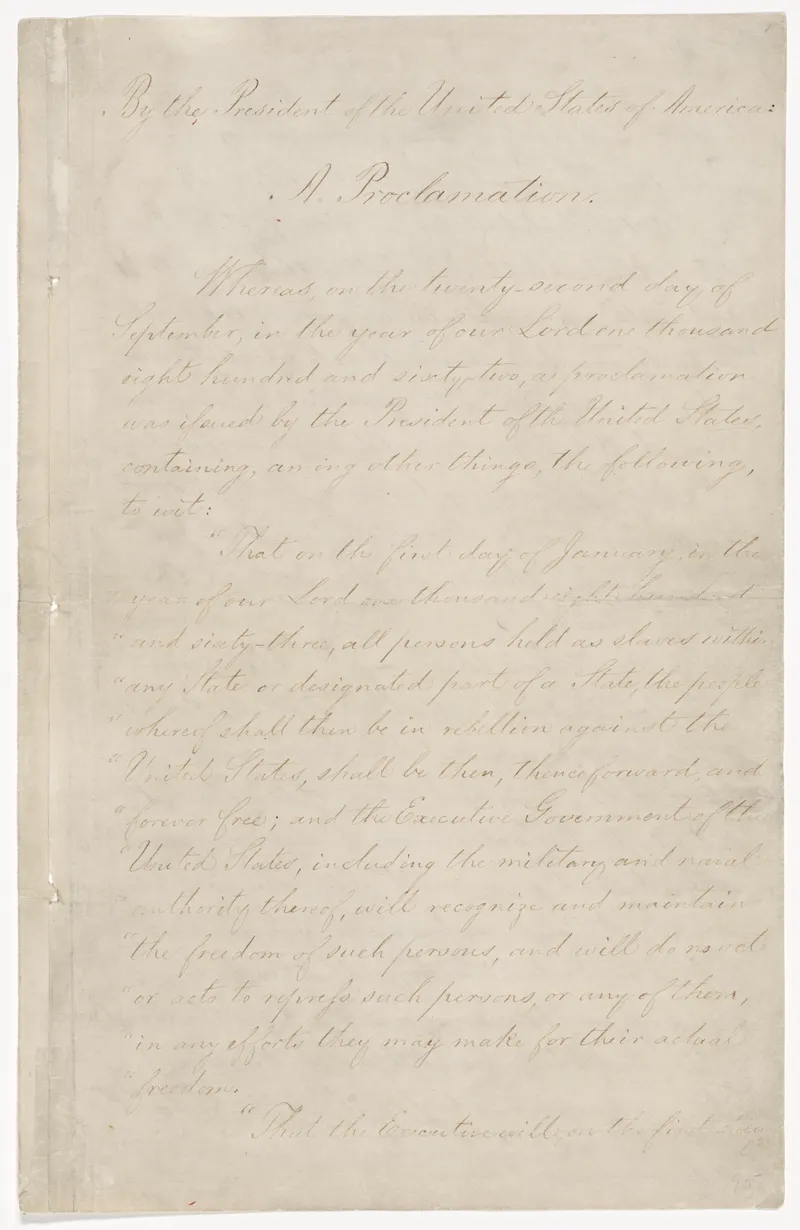
The Emancipation Proclamation freed almost no one in Georgia on the day it was signed. So why did it matter so much?Photo: National Archives
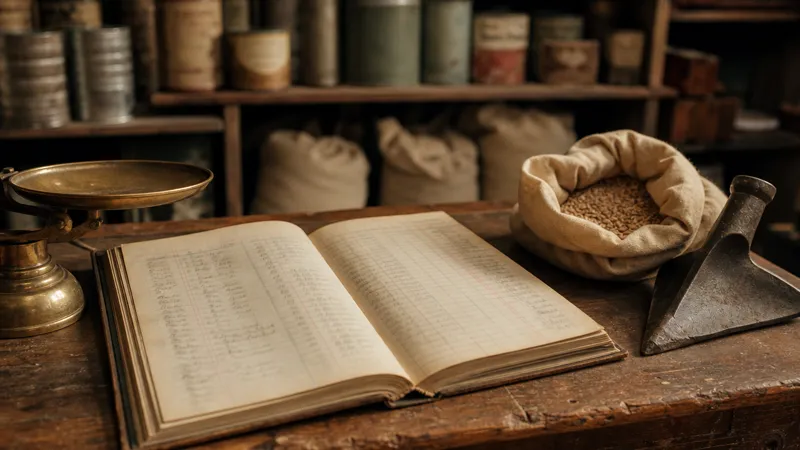
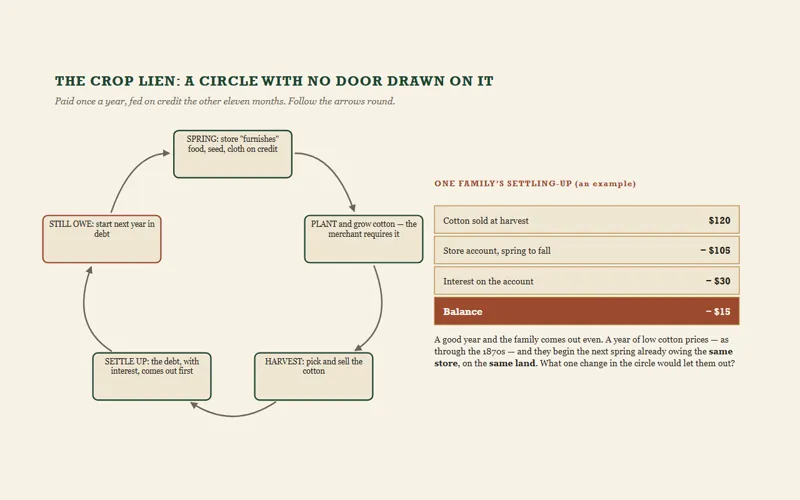
If your family were paid only once a year, at harvest, how would you eat the other eleven months?Illustration (AI-generated)
Word Wall
The 16 words you'll own by the end of this unit. Tap any card to flip it. Words you collect in the activities get a ✓.
Unit Roadmap
Six parts, in the order we'll learn them.
Part 1: The Road to Secession
- Three eras, one century
- Slavery, states' rights and nullification
- The Compromise of 1850, the Georgia Platform and Dred Scott
- Lincoln's election and Georgia's secession debate
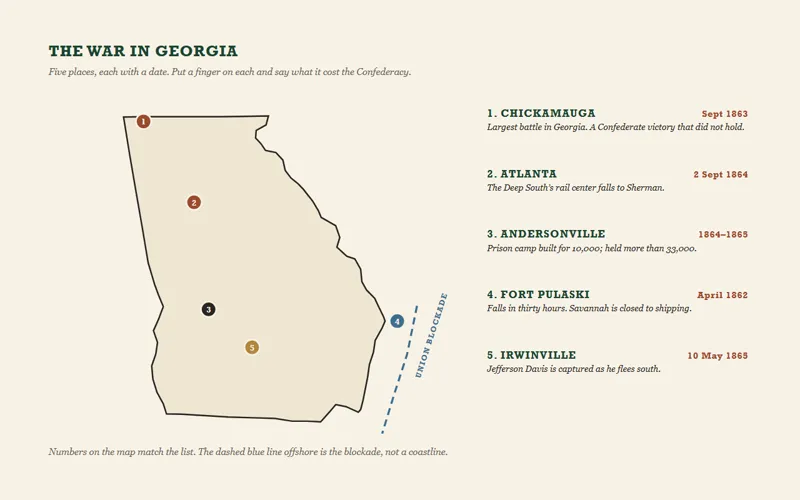
Part 2: Georgia in the War
- The Union blockade and Fort Pulaski
- The Emancipation Proclamation
- Chickamauga
- Andersonville
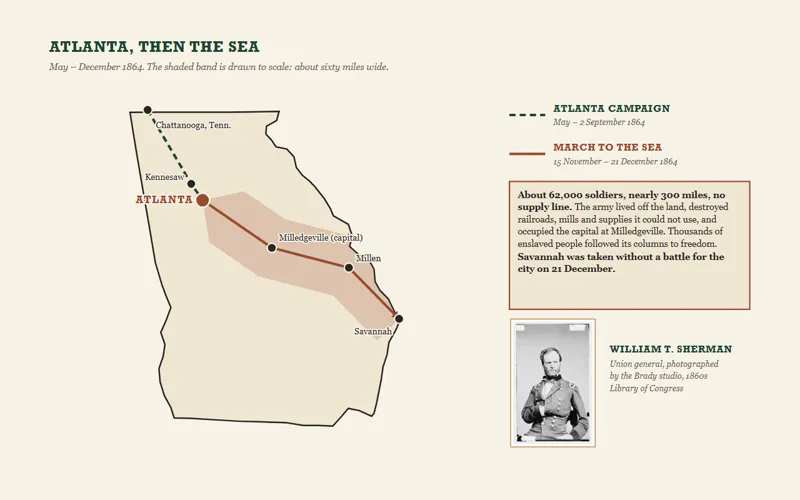
Part 3: Atlanta and the March to the Sea
- The Atlanta Campaign
- Total war
- The March to the Sea
- How the war ended in Georgia
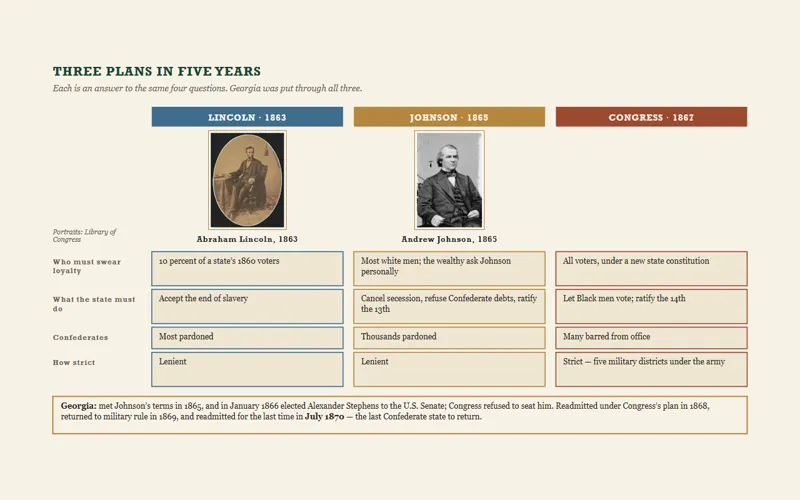
Part 4: Three Plans, Three Amendments
- Lincoln's Ten Percent Plan
- Johnson's plan
- Congressional Reconstruction
- Free, citizens, voters: the three amendments
Part 5: The Bureau, the Klan and the Assembly
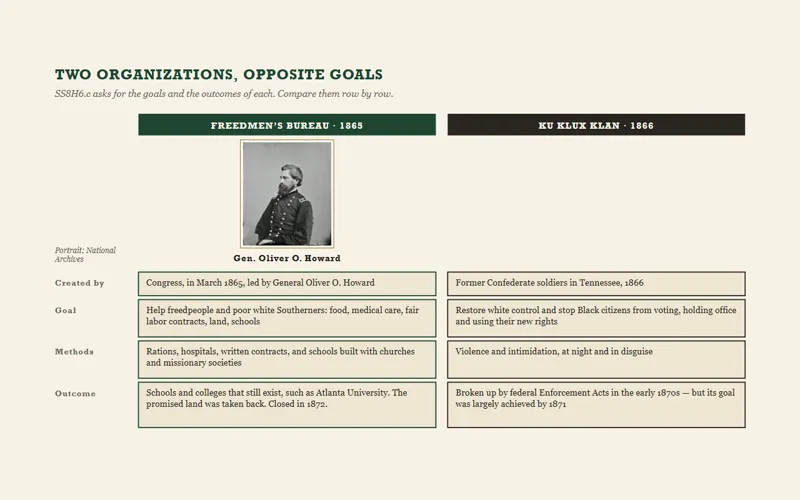
- The Freedmen's Bureau
- "Forty acres"
- The Ku Klux Klan: goals and outcomes
- The expelled legislators, 1868–1870
Part 6: Sharecropping and the New Economy
- Land without labor, labor without land
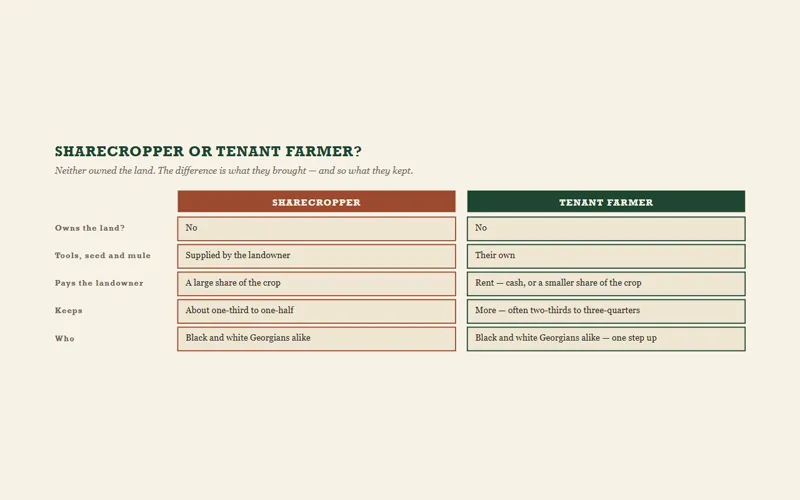
- Sharecropping and tenant farming
- The crop lien
- The end of Reconstruction, 1877
Learning Targets & Success Criteria
I am learning to…
- Explain the issues and events that led Georgia to secede, from the Compromise of 1850 to January 1861
- Explain Georgia's role in the Civil War, from the blockade to the March to the Sea
- Compare the three Reconstruction plans and explain the role of the 13th, 14th and 15th Amendments
- Compare the goals and outcomes of the Freedmen's Bureau and the Ku Klux Klan, and examine why Black legislators were expelled
- Explain how sharecropping, tenant farming and the crop lien worked
I will be successful when I can…
- Place 1850, 1861 and 1877 in the right century and the right era
- Describe slavery, states' rights, nullification, the Compromise of 1850, the Georgia Platform, Dred Scott and Lincoln's election, and how each pushed Georgia toward secession
- State both sides of Georgia's secession debate the way the people holding them argued them
- Locate Fort Pulaski, Chickamauga, Atlanta, Andersonville and Savannah and say what happened at each
- Match each Reconstruction plan and each amendment to what it required or did
- Explain the expulsion of Georgia's Black legislators, its reasons and its effects
- Tell a sharecropper from a tenant farmer and explain why the crop lien kept families in debt
Standards
Analyze the impact of the Civil War on Georgia. Analyze the impact of Reconstruction on Georgia.
Explain the importance of key issues and events that led to the Civil War; include slavery, states' rights, nullification, Compromise of 1850 and the Georgia Platform, the Dred Scott case, Abraham Lincoln's election in 1860, and the debate over secession in Georgia.
Explain Georgia's role in the Civil War; include the Union blockade of Georgia's coast, the Emancipation Proclamation, Chickamauga, Sherman's Atlanta Campaign, Sherman's March to the Sea, and Andersonville.
Explain the roles of the 13th, 14th, and 15th Amendments in Reconstruction.
Explain the key features of the Lincoln, the Johnson, and the Congressional Reconstruction plans.
Compare and contrast the goals and outcomes of the Freedmen's Bureau and the Ku Klux Klan.
Examine reasons for and effects of the removal of African American or Black legislators from the Georgia General Assembly during Reconstruction.
Give examples of goods and services produced during the Reconstruction Era, including the use of sharecropping and tenant farming.
Keep going
Free tools for Civil War & Reconstruction that go deeper.
Maps, diagrams and globes on this page were drawn for this course from real coordinates (coastlines: Natural Earth, public domain). Pictures marked “Illustration (AI-generated)” were generated from written descriptions. They show places, not any real person, and are not photographs of a real location. Photographs are public domain and credited on the picture.