 Tobin
Explore
Jump in anywhere, in any order. Every activity reshuffles each time you play, so there's always something new. You earn acres for every right answer.
Big questions to wonder about
By the end of this unit, you'll be able to answer every one of these.
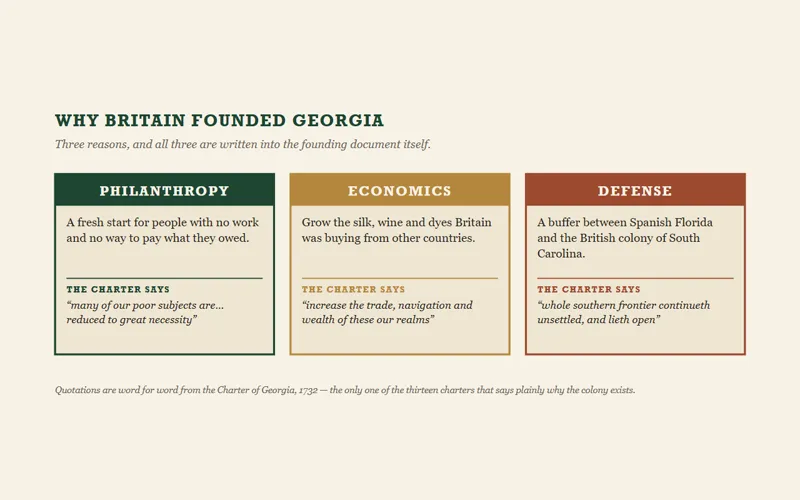
Why would a king hand a colony to 21 men who were forbidden to make a penny from it?
A paper signed in London said the land was Britain’s. So why did Oglethorpe still need Tomochichi’s permission?Illustration (AI-generated)
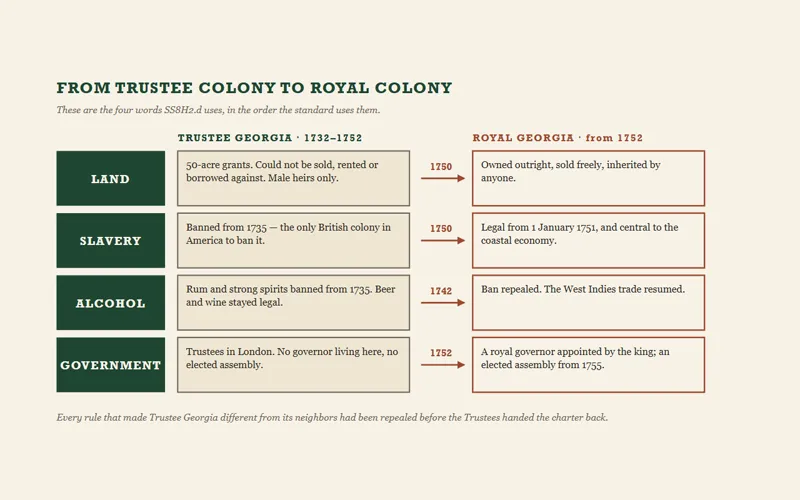
Georgia banned slavery in 1735. Why was the ban gone sixteen years later?

The Trustees planned for silk and wine. Why did Georgia end up selling deerskins and tar?Illustration (AI-generated)
Word Wall
The 16 words you'll own by the end of this unit. Tap any card to flip it. Words you collect in the activities get a ✓.
Unit Roadmap
Five parts, in the order we'll learn them.
Part 1: The Charter of 1732
- Britain’s three problems
- Oglethorpe and the Trustees
- What the charter set up
- Philanthropy, economics and defense
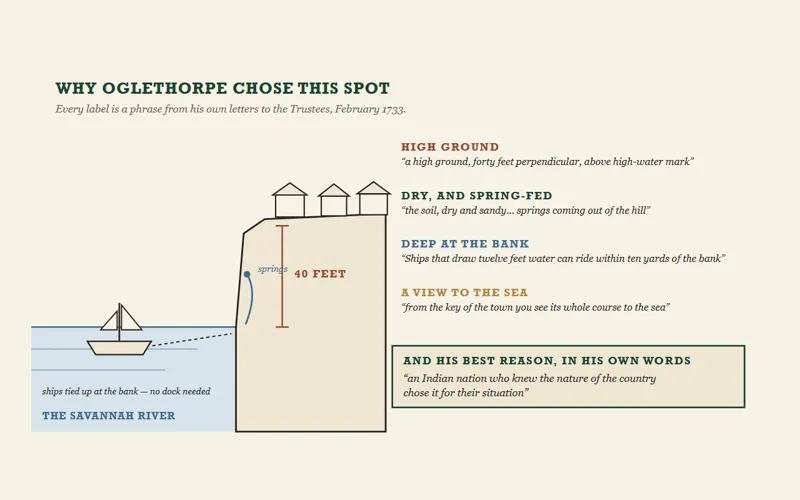
Part 2: Savannah at Yamacraw Bluff
- The voyage of the Anne
- Why Oglethorpe chose the bluff
- Tomochichi and Mary Musgrove
- The town drawn before it was built
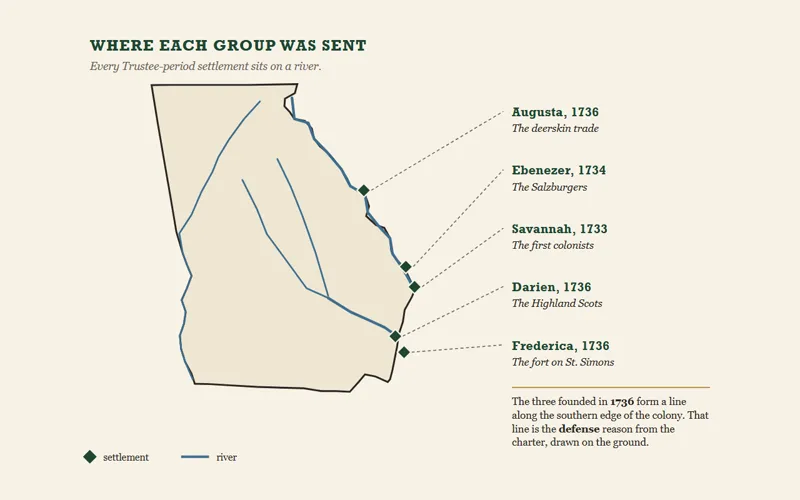
Part 3: The Groups Who Settled Georgia
- A liberty of conscience
- The Jewish colonists and the Salzburgers
- The Highland Scots at Darien
- The Malcontents
Part 4: From Trustee Colony to Royal Colony
- Land
- Slavery
- Alcohol
- Government
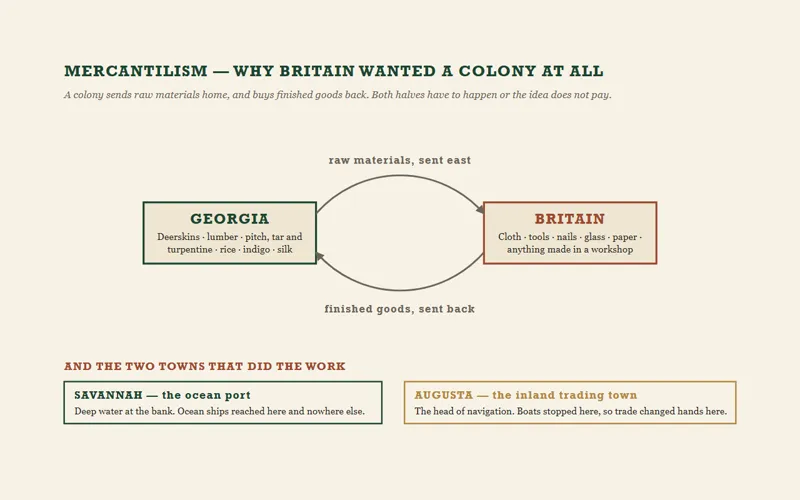
Part 5: Goods, Services and Colonial Trade
- The Trustees’ plan
- What Georgia actually sold
- Goods and services
- Savannah and Augusta
Learning Targets & Success Criteria
I am learning to…
- Explain why Britain founded Georgia and what the Charter of 1732 set up
- Analyze how Oglethorpe, Tomochichi and Mary Musgrove together made Savannah possible
- Evaluate what the Jewish colonists, Salzburgers, Highland Scots and Malcontents gave the colony
- Explain how Georgia changed from a Trustee colony into a royal colony
- Name the goods and services colonial Georgia made, sold and traded, and explain why
I will be successful when I can…
- Name the three reasons for settlement and quote the charter for each one
- Explain what each of the three people at Yamacraw Bluff had that the other two needed
- Compare the four groups: why they came, where they settled, and what they gave
- Describe land, slavery, alcohol and government before and after the change to a royal colony
- Sort colonial work into goods and services, and trace where Georgia’s exports went
- Explain why Augusta grew at the head of navigation and Savannah grew as the port
Standards
Analyze the colonial period of Georgia's history.
Explain the importance of the Charter of 1732, including the reasons for settlement (philanthropy, economics, and defense).
Analyze the relationship between James Oglethorpe, Tomochichi, and Mary Musgrove in establishing the city of Savannah at Yamacraw Bluff.
Evaluate the role of diverse groups (Jews, Salzburgers, Highland Scots, and Malcontents) in settling Georgia during the Trustee Period.
Explain the transition of Georgia into a royal colony with regard to land ownership, slavery, alcohol, and government.
Give examples of the kinds of goods and services produced and traded in colonial Georgia.
Keep going
Free tools for Colonial Georgia that go deeper.
Maps, diagrams and globes on this page were drawn for this course from real coordinates (coastlines: Natural Earth, public domain). Pictures marked “Illustration (AI-generated)” were generated from written descriptions. They show places, not any real person, and are not photographs of a real location.