 Tobin

Explore
Jump in anywhere, in any order. Every activity reshuffles each time you play, so there's always something new. You earn quills for every right answer.
Big questions to wonder about
By the end of this unit, you'll be able to answer every one of these.
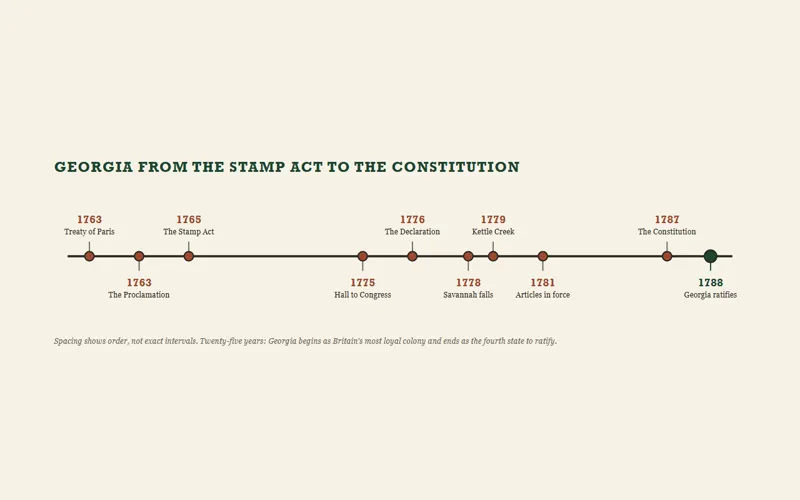
Georgia was the last colony to join the Revolution, yet the fourth state to ratify the Constitution. How can both be true?

Why was Georgia the only colony where stamped paper was ever sold?Illustration (AI-generated)
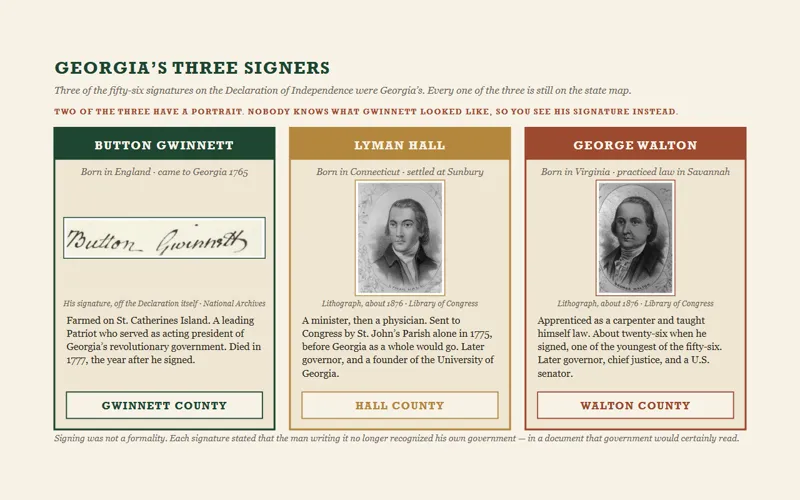
Button Gwinnett has a county named for him, but nobody knows what he looked like. Why not?

How could a small fight beside a creek in Wilkes County matter more than its size?Illustration (AI-generated)
Word Wall
The 16 words you'll own by the end of this unit. Tap any card to flip it. Words you collect in the activities get a ✓.
Unit Roadmap
Five parts, in the order we'll learn them.
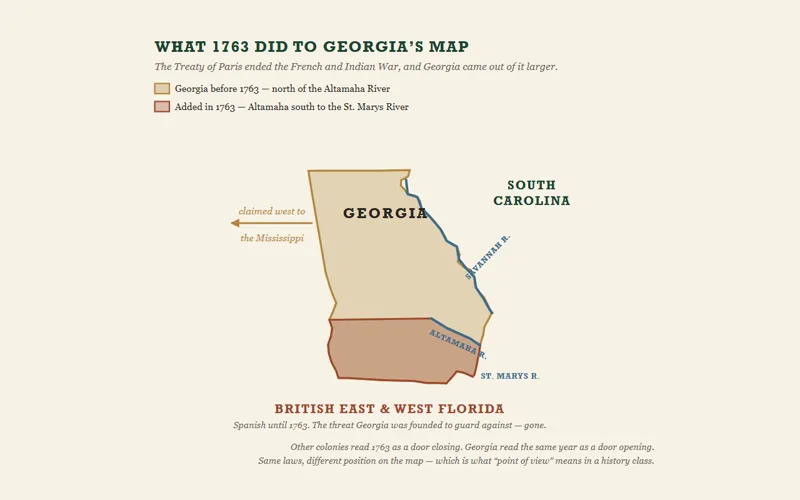
Part 1: A Far-Off War Redraws the Map
- Where Georgia stood in 1754
- The war, and the debt it left
- The Treaty of Paris made Georgia bigger
- The Proclamation of 1763, read from two places
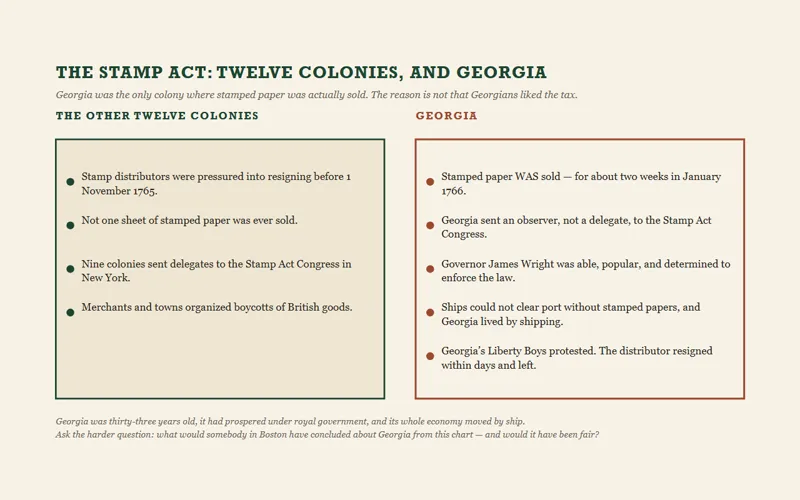
Part 2: A Tax on Paper
- Who should pay for the war?
- A direct tax on printed paper
- “No taxation without representation”
- The only colony where stamps were sold
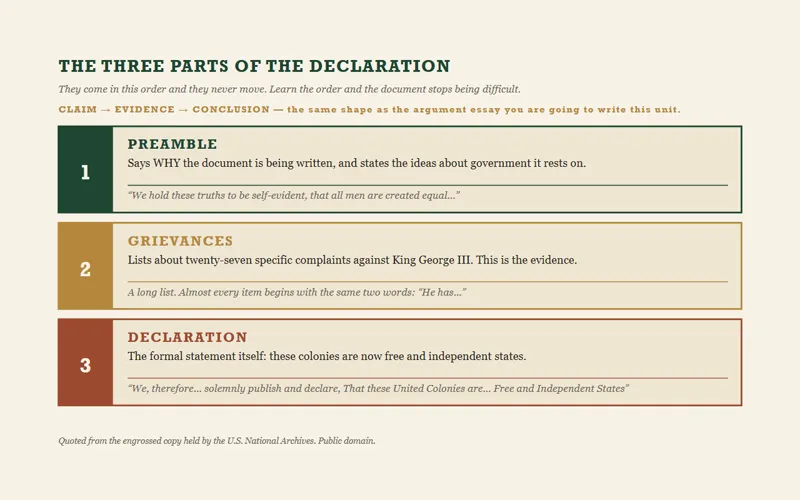
Part 3: The Declaration of Independence
- Georgia joins last
- Preamble, grievances, declaration
- Why the grievances blame the king
- Gwinnett, Hall and Walton
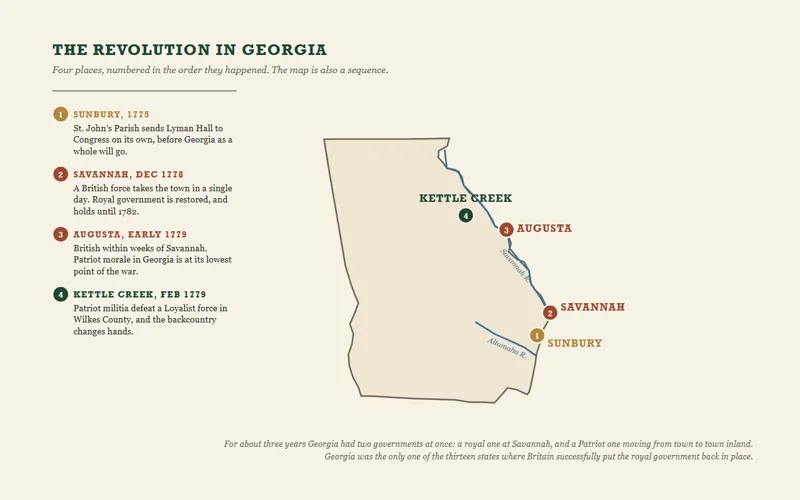
Part 4: Loyalists, Patriots, Kettle Creek and Savannah
- One question, two answers
- Savannah falls and two governments
- Why Kettle Creek mattered
- The Siege of Savannah
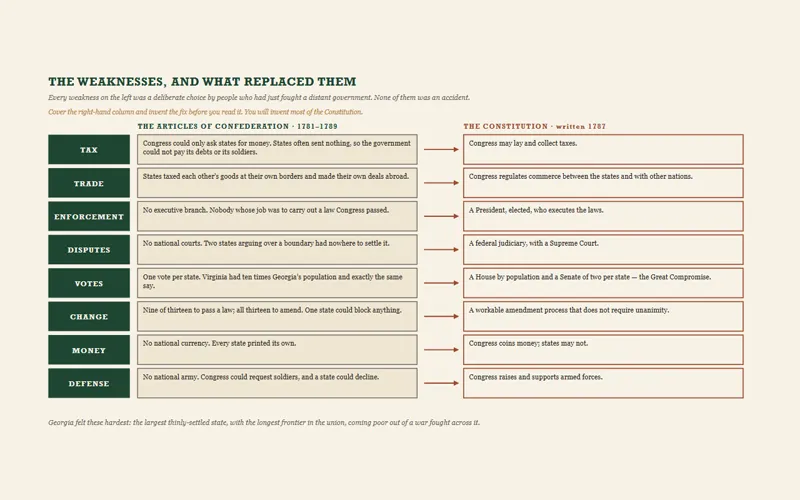
Part 5: The Articles of Confederation
- A government weak on purpose
- What the Articles could and could not do
- Why Georgia felt it hardest
- Baldwin, the Great Compromise and ratifying fourth
Learning Targets & Success Criteria
I am learning to…
- Explain how the French and Indian War, the Proclamation of 1763 and the Stamp Act led toward revolution, and how each one affected Georgia
- Interpret the three parts of the Declaration of Independence and identify Georgia's three signers
- Analyze why Georgians split into Loyalists and Patriots, and what Kettle Creek and the Siege of Savannah meant for Georgia
- Analyze the weaknesses of the Articles of Confederation and explain how they led to the Constitution
I will be successful when I can…
- Trace the chain from a war, to a debt, to a tax, to an argument about representation
- Explain why Georgia read the Proclamation of 1763 as a gain while Virginia read it as a loss
- Sort lines from the Declaration into the preamble, the grievances and the declaration, and say what each part does
- Name Button Gwinnett, Lyman Hall and George Walton and give one fact about each
- State one reason for each side, Loyalist and Patriot, the way that side would have said it
- Explain how each of the two events ended and match each weakness of the Articles to the fix the Constitution made
Standards
Analyze the role of Georgia in the American Revolutionary Era.
Explain the causes of the American Revolution as they impacted Georgia; include the French and Indian War, Proclamation of 1763, and the Stamp Act.
Interpret the three parts of the Declaration of Independence (preamble, grievances, and declaration) and identify the three Georgia signers of the document.
Analyze the significance of the Loyalists and Patriots as a part of Georgia's role in the Revolutionary War; include the Battle of Kettle Creek and Siege of Savannah.
Analyze the weaknesses of the Articles of Confederation and explain how those weaknesses led to the writing of a new federal Constitution.
Keep going
Free tools for American Revolution that go deeper.
Maps, diagrams and globes on this page were drawn for this course from real coordinates (coastlines: Natural Earth, public domain). Pictures marked “Illustration (AI-generated)” were generated from written descriptions. They show places, not any real person, and are not photographs of a real location.