 Tobin
Explore
Jump in anywhere, in any order. Every activity reshuffles each time you play, so there's always something new. You earn points for every right answer.
Big questions to wonder about
By the end of this unit, you'll be able to answer every one of these.

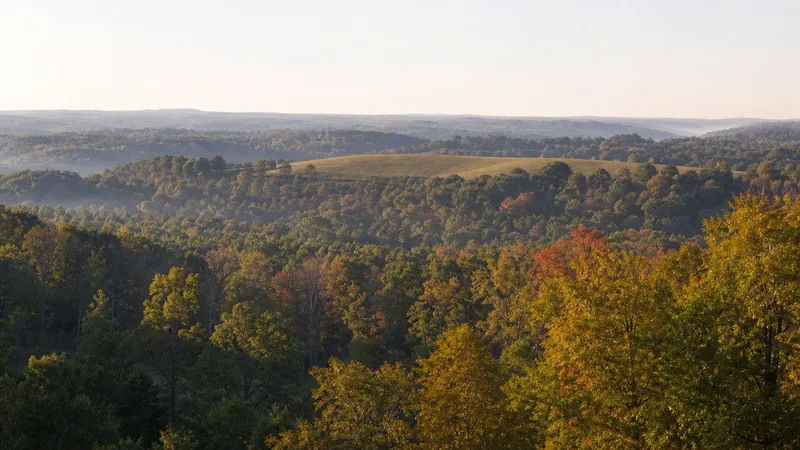
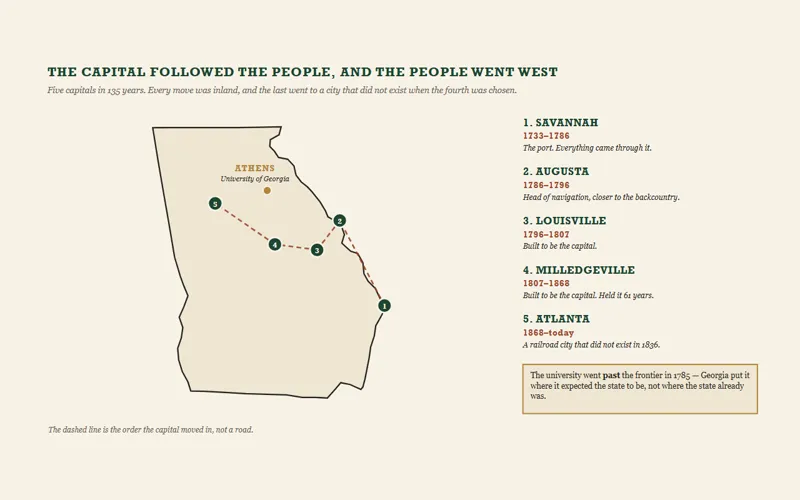
Five capitals in 135 years, and every move went west. Why would a state keep moving its own capital?Photo: Library of Congress, Carol M. Highsmith Archive
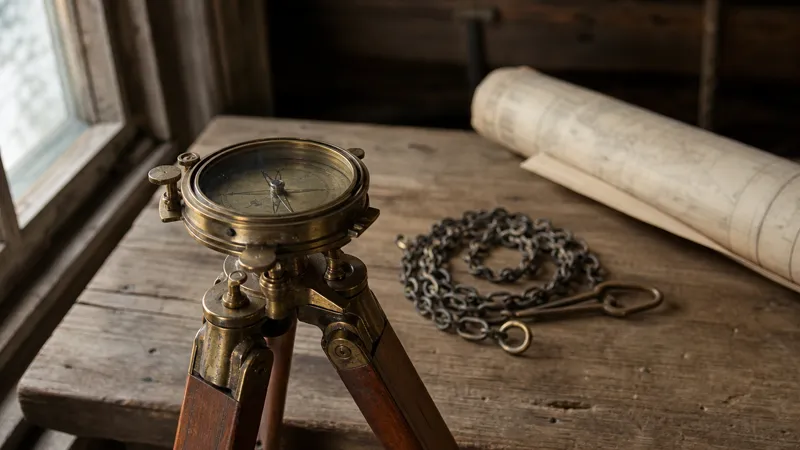
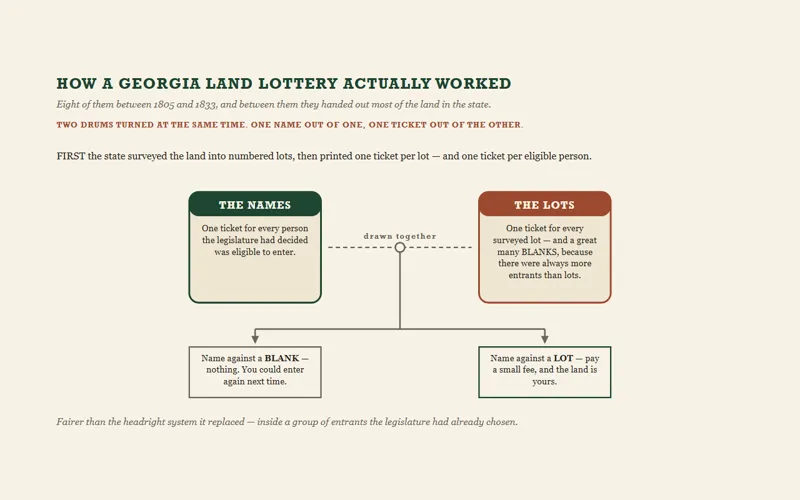
Georgia gave away most of its land in lotteries. Where did all of that land come from?Illustration (AI-generated)
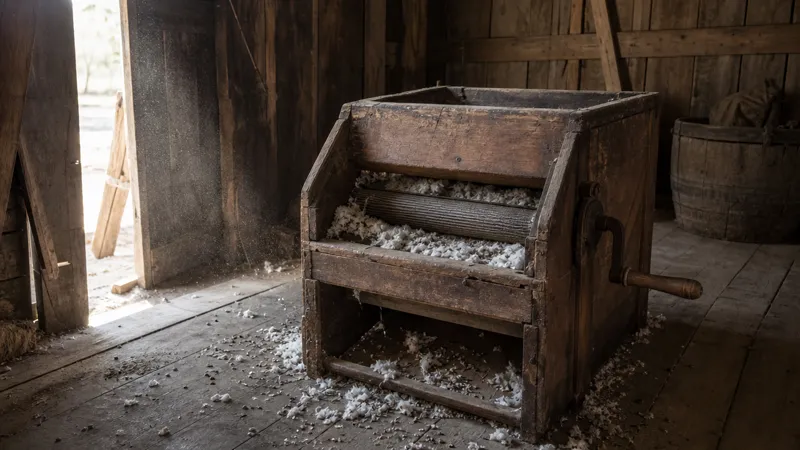
How could one small hand-cranked machine change who lived where across a whole state?Illustration (AI-generated)
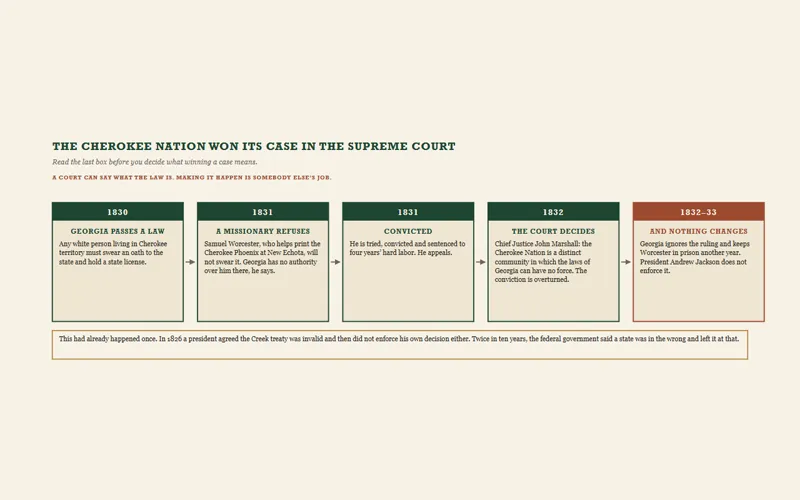
The Supreme Court ruled for the Cherokee side in 1832. Why did the ruling change almost nothing?
Word Wall
The 16 words you'll own by the end of this unit. Tap any card to flip it. Words you collect in the activities get a ✓.
Unit Roadmap
Five parts, in the order we'll learn them.
Part 1: The Capitals Move West
- A capital is a decision, not a fact
- Five capitals, from the coast to the railroad city
- The University of Georgia, chartered 1785
- One pattern behind two facts
Part 2: Who Got the Land
- Land-rich, cash-poor Georgia
- The headright system
- The Yazoo Land Fraud and the rescinding act
- Eight land lotteries, and what they did not settle
Part 3: The Gin and the Railroad
- The one slow step
- Eli Whitney's cotton gin, 1793
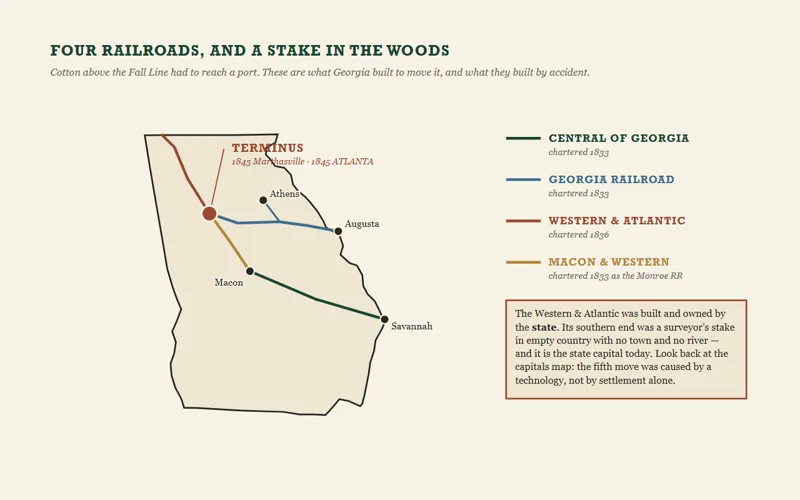
- Railroads past the Fall Line
- Terminus becomes Atlanta
Part 4: William McIntosh and the Creek
- The Muscogee (Creek) Nation
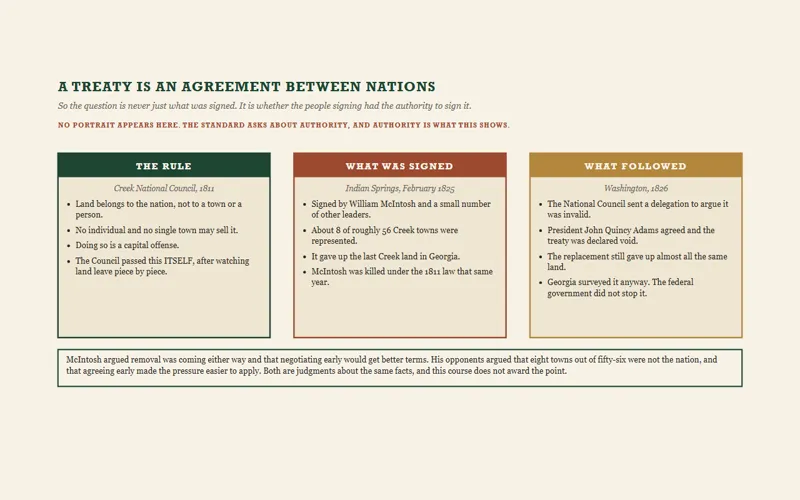
- The National Council's 1811 law
- The Treaty of Indian Springs, 1825
- The Treaty of Washington, 1826
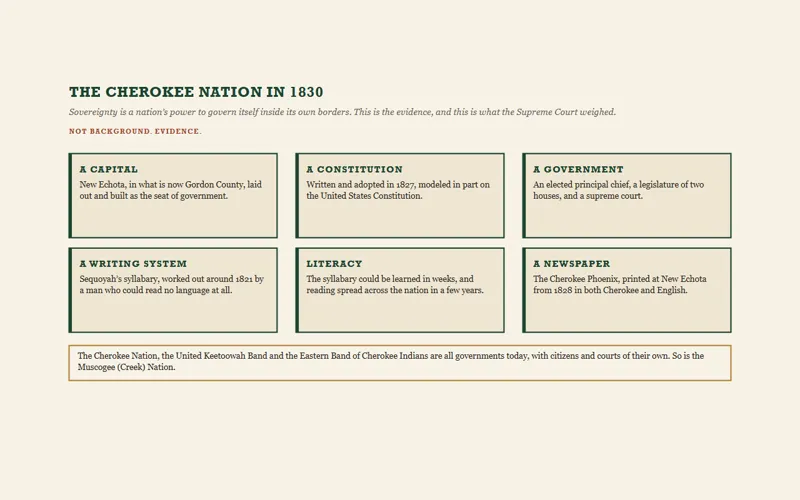
Part 5: The Cherokee, the Court, and Removal
- The Cherokee Nation in 1830
- Gold near Dahlonega and Georgia's new laws
- Worcester v. Georgia, 1832
- The Treaty of New Echota and removal in 1838–39 (the Trail of Tears); both nations continue today
Learning Targets & Success Criteria
I am learning to…
- Explain why Georgia founded its state university and why its capital kept moving west
- Evaluate Georgia's land policies: the headright system, the Yazoo Land Fraud, and the land lotteries
- Explain how the cotton gin and the railroads changed Georgia's growth
- Describe William McIntosh's role in the removal of the Muscogee (Creek) from Georgia
- Analyze how John Ross, John Marshall, Andrew Jackson, the Dahlonega gold rush and Worcester v. Georgia led to the removal of the Cherokee
I will be successful when I can…
- Name Georgia's five capitals in order and explain why each move went west
- Explain why the University of Georgia's 1785 charter was a first and why Athens was an unexpected place for it
- Compare the headright system and the land lottery, and tell the story of the Yazoo Land Fraud from sale to court case
- Trace the chain from the cotton gin to more cotton, more demand for land and more demand for enslaved labor
- Explain how the railroads met at Terminus and turned it into Atlanta
- State McIntosh's position and the National Council's position on the Treaty of Indian Springs without choosing a side
- Explain what Worcester v. Georgia decided and why it was not enforced
Standards
Explain significant factors that affected westward expansion in Georgia between 1789 and 1840.
Explain reasons for the establishment of the University of Georgia, and for the westward movement of Georgia's capitals.
Evaluate the impact of land policies pursued by Georgia; include the headright system, land lotteries, and the Yazoo Land Fraud.
Explain how technological developments, including the cotton gin and railroads, had an impact on Georgia's growth.
Describe the role of William McIntosh in the removal of the Muscogee (Creek) from Georgia.
Analyze how key people (John Ross, John Marshall, and Andrew Jackson) and events (Dahlonega Gold Rush and Worcester v. Georgia) led to the removal of the Cherokees from Georgia known as the Trail of Tears.
Keep going
Free tools for Westward Expansion & Indian Removal that go deeper.
Maps, diagrams and globes on this page were drawn for this course from real coordinates (coastlines: Natural Earth, public domain). Pictures marked “Illustration (AI-generated)” were generated from written descriptions. They show places, not any real person, and are not photographs of a real location. Photographs are public domain and credited on the picture.