 Tobin
TobinExplore
Jump in anywhere, in any order. Every activity reshuffles each time you play, so there's always something new. You earn newtons for every right answer.
Big questions to wonder about
By the end of this unit, you'll be able to answer every one of these.

Why did the hammer and the feather land together on the Moon?

A race car goes around a track at a steady 50 m/s. Is it accelerating?

When a bus stops suddenly, why do you lurch forward — what pushed you?
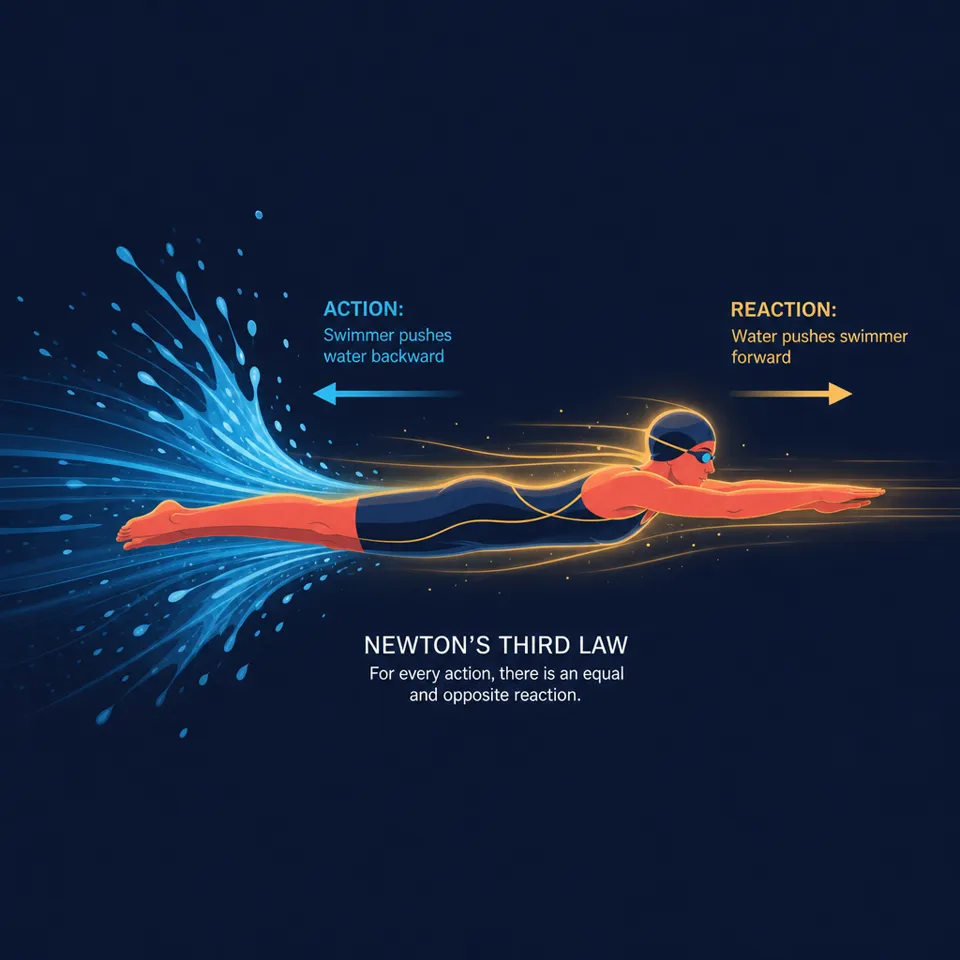
A swimmer pushes water backward. So why does the swimmer go forward?
Word Wall
The 14 words you'll own by the end of this unit. Tap any card to flip it. Words you collect in the activities get a ✓.
Unit Roadmap
Five parts, in the order we'll learn them.

Part 1: Describing Motion
- What counts as motion
- Scalars & vectors
- Speed & velocity

Part 2: Motion Graphs
- Distance-time graphs
- Velocity-time graphs
- Matching a graph to its story

Part 3: Acceleration & Free Fall
- Acceleration
- Free fall at 9.8 m/s²
- Mass vs. weight (W = mg)

Part 4: Newton's 1st & 2nd Laws
- Force & net force
- Inertia
- F = ma

Part 5: Newton's 3rd Law & Free Body Diagrams
- Action-reaction pairs
- Free body diagrams
- Net force from an FBD
Learning Targets & Success Criteria
I am learning to…
- Distinguish between Newton's 3 Laws of Motion
- Use Newton's 3 Laws to describe the motion of an object
- Identify balanced and unbalanced forces on an object
- Calculate force, mass or acceleration given initial conditions
- Identify the action-reaction pairs in a given scenario
I will be successful when I can…
- Identify which of Newton's 3 Laws is present in a real-world scenario
- Explain that an object at rest will stay at rest, and an object in motion will remain in motion until an unbalanced force acts on that object
- Determine when an object is in equilibrium using free body diagrams
- Recognize that objects in equilibrium can be at rest or have constant velocity
- Calculate the net force on object
- Determine movement of an object based on net force and direction of forces
Standards
Obtain, evaluate, and communicate information to explain the relationships among force, mass, and motion.
Plan and carry out an investigation to analyze the motion of an object using mathematical and graphical models.
Construct an explanation based on experimental evidence to support the claims presented in Newton's three laws of motion.
Analyze and interpret data to identify the relationship between mass and gravitational force for falling objects.