Learning targets

Georgia SPS4.a — Develop a model that illustrates how the nucleus changes as a result of fission and fusion.
Target 1 · Fission
  • I can model how a heavy nucleus splits when it absorbs a neutron.
  • I can write and balance a fission equation.
Target 2 · Chain reactions
  • I can explain how the neutrons released by one fission cause more fissions.
  • I can explain how control rods keep a reactor steady instead of runaway.
Target 3 · Fusion
  • I can model how two light nuclei join to form a heavier one.
  • I can explain why fusion needs enormous temperature and pressure.
Target 4 · Comparing them
  • I can compare fission and fusion by fuel, products, conditions, and where each one happens.
  • I can explain where the released energy comes from.

Two opposite moves, both release energy
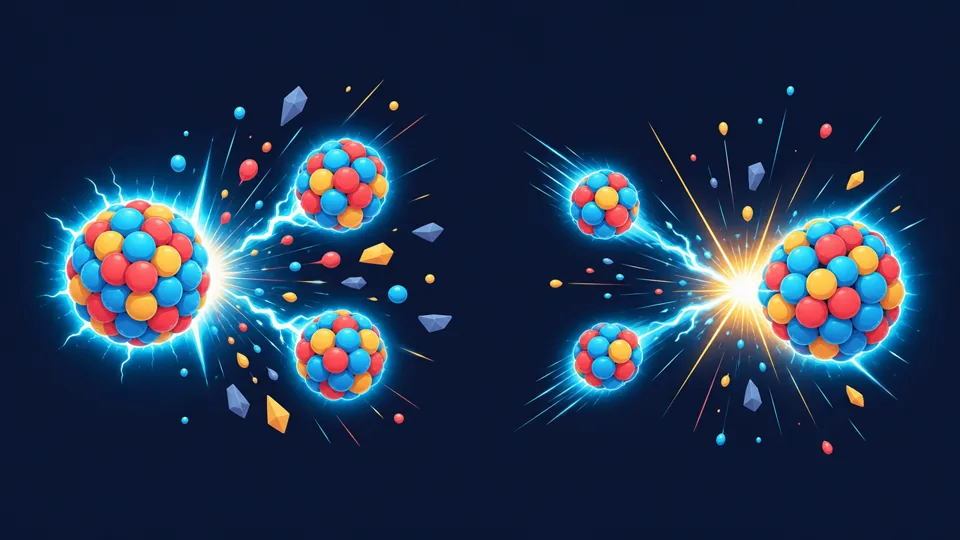
On the left a large nucleus splitting into two; on the right two small nuclei joining into one
Left: fission. One big nucleus breaks into two smaller ones. Right: fusion. Two small nuclei slam together into one bigger one.
Fission — splitting
Take a very heavy nucleus, hit it with a neutron, and it breaks into two medium pieces plus spare neutrons. This is what happens inside every nuclear power plant on Earth.
Fusion — joining
Take two very light nuclei and force them close enough that the strong force grabs them. They merge into one heavier nucleus. This is what powers the Sun and every other star.
The mix-up to avoid. Fission is splitting — both words have the "s" sound in the middle, and a fissure is a crack. Fusion is fusing — the same word you use for welding things together. If you can keep those two straight you are most of the way through this page.
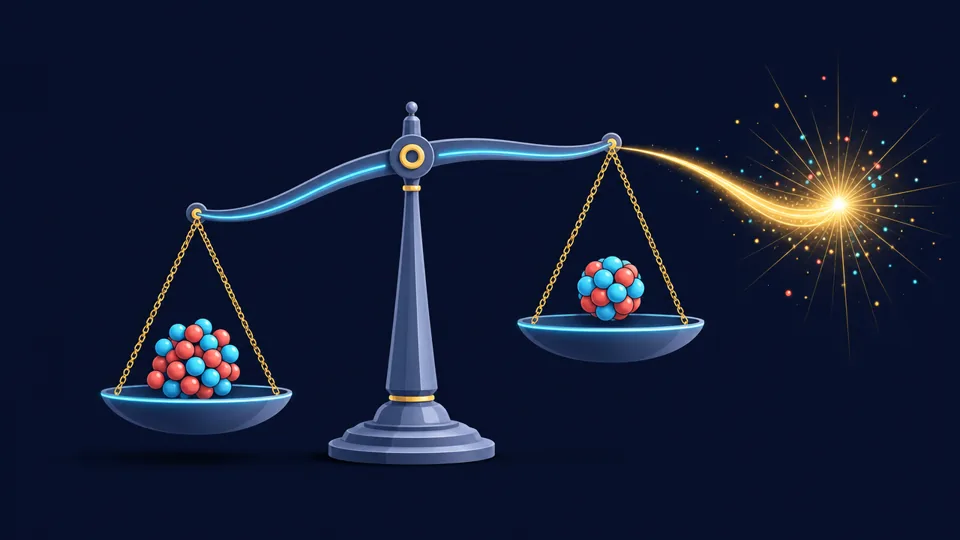
Where does the energy come from? Add up the mass of everything before, then add up the mass of everything after. The "after" is always slightly lighter. That missing mass — a tiny fraction of a percent — is what becomes energy. A very small amount of mass converts into an enormous amount of energy, which is why nuclear reactions release millions of times more energy per atom than burning coal does.
A balance showing the products of a nuclear reaction weighing slightly less than the reactants
The products really do weigh less than what you started with. The difference left as energy.
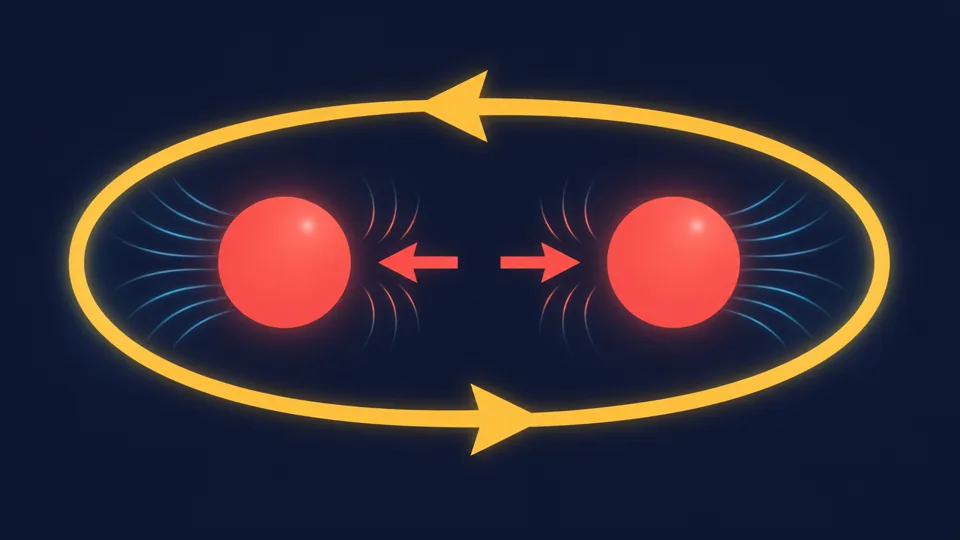
Two nuclei held by the short-range strong nuclear force
Both reactions are a fight between the strong force (pulls nucleons together, very short range) and electric repulsion (pushes protons apart, long range).

The Fission Lab

Fire a neutron at uranium-235 and watch what comes out. Run it a few times — the same nucleus does not split the same way twice.

Press "Fire a neutron".
Why the products change every time. A splitting nucleus does not break neatly in half. It tears into two uneven pieces, and which pieces you get is down to chance. Barium and krypton is the classic textbook pair, but xenon and strontium, or cesium and rubidium, are just as real. What is always true: both sides of the equation balance, and two or three spare neutrons come flying out. Those spare neutrons are the entire reason a chain reaction is possible.

The Chain Reaction Lab

Every fission throws out spare neutrons. If those neutrons find more uranium, they split it too. Drop the control rods in and out and watch what happens.

rods fully out (nothing absorbed)rods fully in
supercritical
0
generations
0
nuclei split
2.50
neutrons causing
the next split (k)
64
fuel remaining
Leave the rods out and press Start. Then reset, push the rods most of the way in, and try again.
k < 1 — subcritical
Each fission causes less than one more. The reaction fades out and dies. This is a reactor shutting down.
k = 1 — critical
Each fission causes exactly one more. Steady, constant power output. This is what a working power plant runs at, all day, every day.
k > 1 — supercritical
Each fission causes more than one more. The rate doubles and doubles. Power output climbs out of control.
The question every class asks: can a nuclear power plant explode like a bomb? No — and the reason is the fuel, not the safety systems. A bomb needs uranium enriched to about 90% U-235. Reactor fuel is enriched to about 3–5%; the other 95% is U-238, which absorbs neutrons without splitting. There is simply not enough fissile material packed closely enough for a nuclear explosion to be physically possible. Reactors can and do fail in other serious ways — overheating, melting, steam and hydrogen explosions, released radioactive material — and Chernobyl and Fukushima were catastrophic. But those are not nuclear detonations, and the difference is worth being precise about.
One split becomes two, two become four. Doubling is how a chain reaction gets out of hand fast.
What the reactor is actually doing
  • Fuel rods hold the uranium pellets
  • Control rods (boron or cadmium) soak up spare neutrons. Push them in to slow the reaction, pull them out to speed it up
  • Moderator (usually water) slows the neutrons down, because slow neutrons are far better at splitting U-235 than fast ones
  • Coolant carries the heat away to boil water into steam
And then something almost disappointing happens: the steam spins a turbine, exactly like a coal plant. All that nuclear physics is a very sophisticated way of boiling water.

The Fusion Lab

Two nuclei, both positive, both pushing each other away. Turn up the temperature until they are moving fast enough to crash through that repulsion.
cold150 million °C
Temperature: 1,500,000 °C
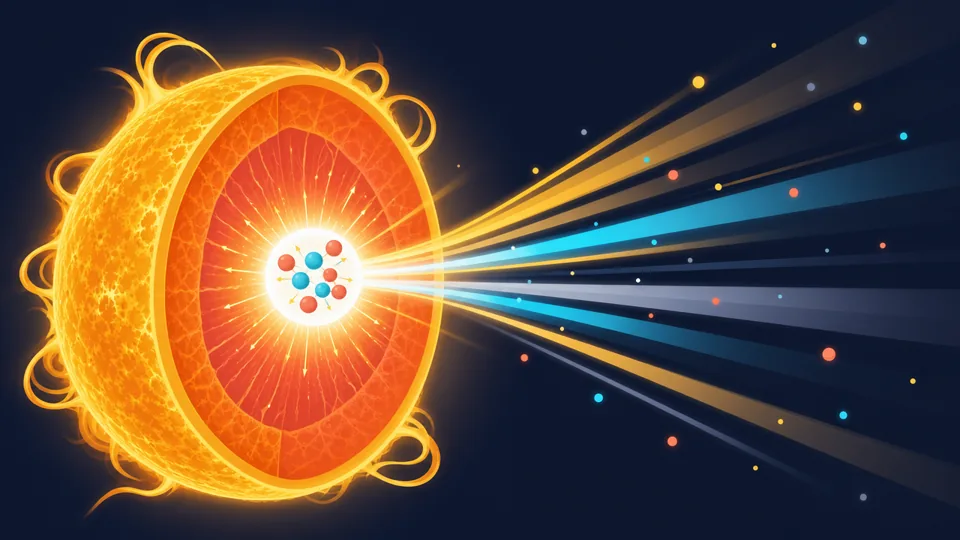
The blazing core of a star where fusion takes place
The Sun's core: about 15 million °C and crushed under the weight of the entire star.
Why fusion is so hard
Both nuclei are positively charged, so they repel each other fiercely, and that repulsion gets stronger the closer they get. The strong force only takes over at the very last moment — about one nucleon's width apart.
To get that close, the nuclei have to be moving at a staggering speed. That means temperatures of millions of degrees. The Sun also uses crushing gravitational pressure to help. On Earth we have no such gravity, so experimental reactors have to run hotter than the Sun's core — around 150 million °C.
Worth the trouble? Fusion's fuel is hydrogen, effectively limitless from seawater. Its main product is helium, which is harmless. It cannot run away, because the moment conditions slip the reaction just stops. The catch is that no fusion power plant has ever delivered electricity to a grid — keeping something that hot stable for long enough is still an unsolved engineering problem.
Two light nuclei merging into one heavier nucleus, with energy released.
The reaction in the Sun, simplified
Four hydrogen nuclei (single protons) end up as one helium-4 nucleus, two positrons, and a great deal of energy. It happens in several steps, not all at once.
4 11H  →  42He  +  energy
Experimental reactors on Earth use a faster version, fusing two heavy forms of hydrogen — deuterium and tritium — because it works at a "lower" temperature.

Side by side

The one thing they share. Both move the nucleus toward iron. Iron-56 is the most tightly bound nucleus there is — the bottom of the valley. Anything heavier than iron releases energy by splitting down toward it, and anything lighter releases energy by fusing up toward it. That single idea explains why fission needs heavy fuel and fusion needs light fuel, and it is why stars stop producing energy once their cores turn to iron.

One-minute videos

Fission & fusion (SPS4.a)
Nuclear energy (SPS4.c)
Balancing these equations comes from Nuclear Notation. What to do with all this power is Nuclear Energy: The Arguments.

How are you feeling about this today?

Nothing here is graded. Switch levels any time.

Printable worksheets

Student page first, answer key on the next page. Shuffle to pull a fresh set.

Levels 2 and 3 need a periodic table, because students turn an atomic number back into a symbol. The Periodic Table Explorer works offline if you are short on paper copies.

Standard and targets

Georgia SPS4.a — Develop a model that illustrates how the nucleus changes as a result of fission and fusion.

The verb is develop a model, so the three labs on this page are the deliverable, not decoration. Students fire a neutron and watch the nucleus break, run a chain reaction and control it, and raise the temperature until fusion becomes possible. Each lab writes the balanced equation alongside the animation so the model and the notation stay connected.

  • Target 1: fission mechanics and balanced fission equations.
  • Target 2: chain reactions, k, criticality, and what control rods do.
  • Target 3: fusion mechanics and why the conditions are so extreme.
  • Target 4: comparison across fuel, products, conditions, and location.

How the levels differ

Level 1 · Coach
Two-choice sorting: splitting or joining, heavy or light fuel, Sun or power plant. The coach gives the fis/fus memory hook before every item.
Level 2 · Guided
Four-choice: balance a fission equation for the missing product, decide what happens when rods move, and match properties to the right reaction. Distractors are the swapped-reaction errors.
Level 3 · Challenge
Missing pieces anywhere in an equation, k-value reasoning, mass-to-energy explanation, and the reactor-versus-bomb question with all four plausible-sounding answers on the table.

Misconceptions this page argues with by name

  • Fission and fusion swapped. The single most common error on this standard. Every wrong answer that swaps them says so directly, and the fis/fus hook is repeated in the coach line.
  • "A reactor can explode like a nuclear bomb." Answered with the enrichment numbers rather than with reassurance — 3–5% versus about 90%. The page is equally clear that reactors can fail catastrophically in other ways, so students are not left with the opposite false impression.
  • "Fusion happens in nuclear power plants." Every operating plant on Earth runs on fission. No fusion plant has ever supplied a grid.
  • "The bigger nucleus always releases more energy." Handled with the iron idea: heavy nuclei release energy by splitting, light ones by fusing, and both move toward iron.
  • "Nuclear plants make electricity directly from the atom." The heat boils water and the steam spins a turbine, exactly as in a coal plant. Students find this genuinely surprising.

Classroom notes

  • Fire the Fission Lab five times before explaining anything. Students will notice the products change each time and ask why. That question is the lesson: fission is not a tidy halving, and the equation balances regardless.
  • The mousetrap-and-ping-pong-ball demo is the physical version of the chain reaction lab, if you have the space and the nerve. The simulator is the version you can run twice in a class period.
  • Run the chain reaction with rods out, then with rods most of the way in, and put the two k values side by side. Critical at exactly 1 is the number worth dwelling on — a working power plant is holding a runaway reaction at precisely break-even, continuously.
  • Let the reactor-versus-bomb question come up naturally and then answer it with the enrichment numbers. Being precise here buys you credibility for the arguments page, because students can tell the difference between an explanation and a reassurance.
  • The "it just boils water" reveal is a reliable moment. Ask the class how they think a nuclear plant turns fission into electricity before you tell them.
  • Nothing is collected: no names, no codes.