Pick a page
Four pages, one per element of the standard. Each one opens with learning targets and I-can statements, then runs Learn → Practice → Print → Teacher Tools. Nothing is collected — no names, no codes, no logins.
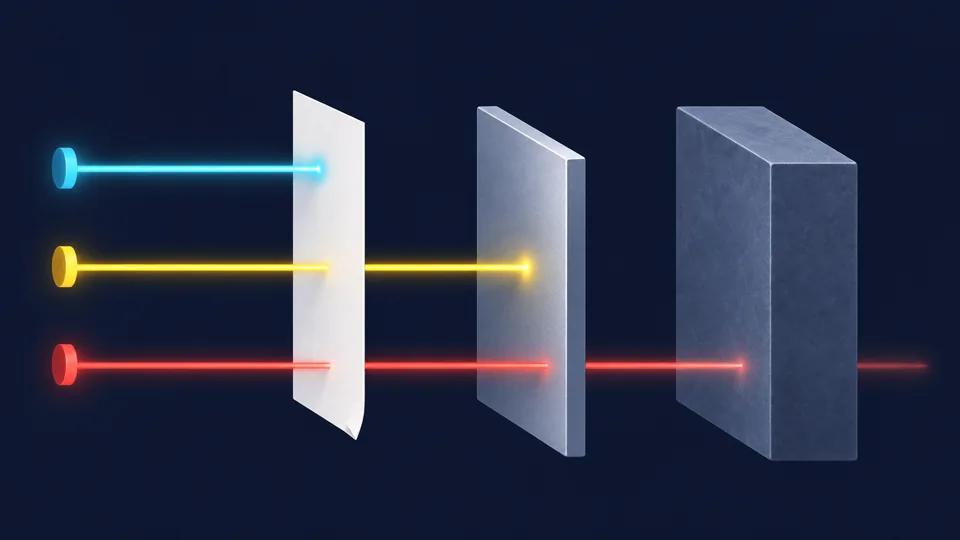
Nuclear Notation & Radioactive Decay
What is inside the nucleus, how to write any isotope, and what alpha, beta and gamma do to it.
- Build any isotope and watch the mass number move while the atomic number stays put — the mistake that wrecks the rest of the unit
- A Decay Lab that fires alpha, beta or gamma at fifteen real isotopes, writes the equation, and shows both balance rows
- Balancing nuclear equations, with the beta surprise staged deliberately: the atomic number goes up
- The full uranium-238 chain to lead-206, clickable step by step, including the radon that ends up in basements
- Three levels plus a speed round, and three worksheets with keys
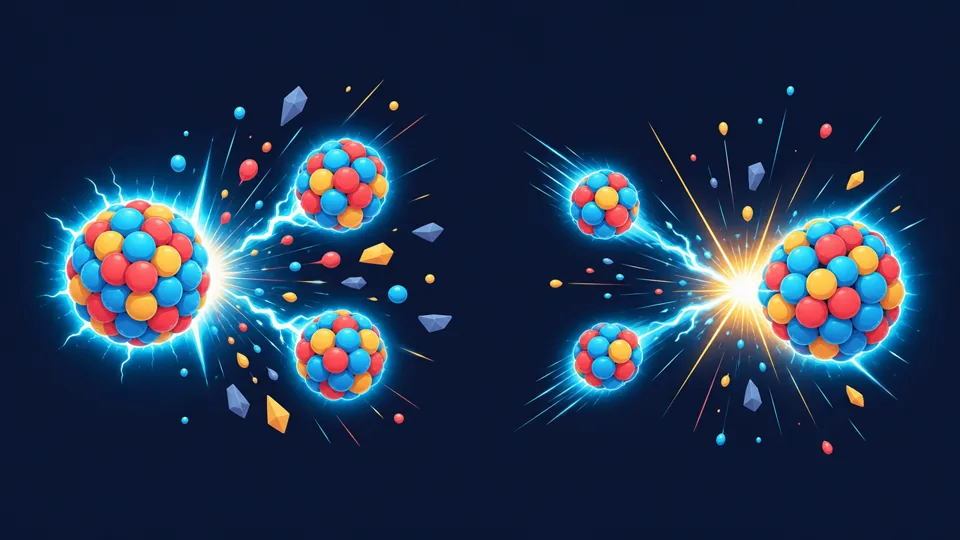
Fission & Fusion
The two ways a nucleus changes that are not decay — with three labs students actually operate.
- Fire a neutron at uranium-235 and watch it split. Fire it again and get a different real product pair, which is the point
- A chain reaction with a control rod slider: 2.50 supercritical, 1.01 critical, 0.70 subcritical, all running live
- A fusion lab where you raise the temperature until the nuclei finally break through their own repulsion
- "Can a reactor explode like a bomb?" answered with the enrichment numbers — and honest about how reactors can fail
- Three levels plus a speed round, and three worksheets with keys

Half-Life
Three routes to the same answer — a table, a formula, and a graph — so every student has one that works.
- A 400-atom simulator that draws the real curve against the predicted one. They never quite match, and that is the lesson
- A halving table you build one row at a time, which is enough to solve every problem on the page
- N = N0(½)n worked forwards and backwards: find the mass, the time, or the starting amount
- A decay curve you click to read values off, plus carbon dating and seventeen real isotopes
- Feedback that names the mistake — subtracting instead of halving, "gone after two half-lives," dividing by n

Nuclear Energy: The Arguments
An argument standard, so the page is built deliberately balanced — and says so on the page.
- Twelve evidence cards supporting nuclear power and twelve on the problems. The count is printed so students can check it
- Six case studies, each with equal evidence for and against: Plant Vogtle in Burke County, Chernobyl, Fukushima, Three Mile Island, the waste problem, and the uses beyond electricity
- A Stance Meter that hands you the three strongest arguments against whatever position you just picked
- Practice on claim and evidence, fact versus opinion, misused evidence, and finding the counterargument that actually lands
- A debate prep printable scored with a rubric — both sides earn identical marks
What the standard asks for
SPS4 and its three elements, and where each one lives.
SPS4
Explain the changes in nuclear structure from fission, fusion and radioactive decay. → Notation & Decay, plus the notation the whole unit runs on.
SPS4.a
Develop a model illustrating how the nucleus changes in fission and fusion. → Fission & Fusion, where the three labs are the model.
SPS4.b
Use mathematics and computational thinking to explain half-life. → Half-Life, with a table, a formula and a graph.
SPS4.c
Construct arguments from evidence about applications, benefits and problems. → Nuclear Energy: The Arguments.
Related
Other free tools that pair well with the nuclear unit.
Periodic Table Explorer
Students convert an atomic number back into an element symbol constantly on these pages. If that is shaky, run this first — it works with the wifi off.
Open the Explorer →
Simple Science Videos
One-minute videos for all three elements of SPS4, in plain language. They are embedded on the pages too, but this is the whole library.
Browse the videos →
Chemistry Activities
Periodic table patterns, naming compounds, counting atoms, balancing equations and the matter unit — all the other chemistry pages.
Back to Chemistry →