What is inside the nucleus, how to write any isotope, what alpha, beta, and gamma do to it, and how to balance a nuclear equation.
Learning targets
Georgia SPS4 — Obtain, evaluate, and communicate information to explain the changes in nuclear structure as a result of fission, fusion and radioactive decay. This page is the radioactive decay half, and the notation everything else is built on.
Target 1 · Inside the nucleus
I can explain what holds a nucleus together and why some nuclei are unstable.
I can explain that radioactive decay is a change in the nucleus, not in the electrons.
Target 2 · Nuclear notation
I can read an isotope symbol and name the mass number and the atomic number.
I can find the protons, neutrons, and electrons in any neutral isotope.
Target 3 · Alpha, beta, gamma
I can describe each type of radiation by mass, charge, and penetrating power.
I can say what each one does to the mass number and the atomic number.
Target 4 · Nuclear equations
I can balance a nuclear equation so both the mass numbers and the atomic numbers add up.
I can find a missing particle or a missing daughter nucleus in an equation.
Start here: the nucleus is a crowded place
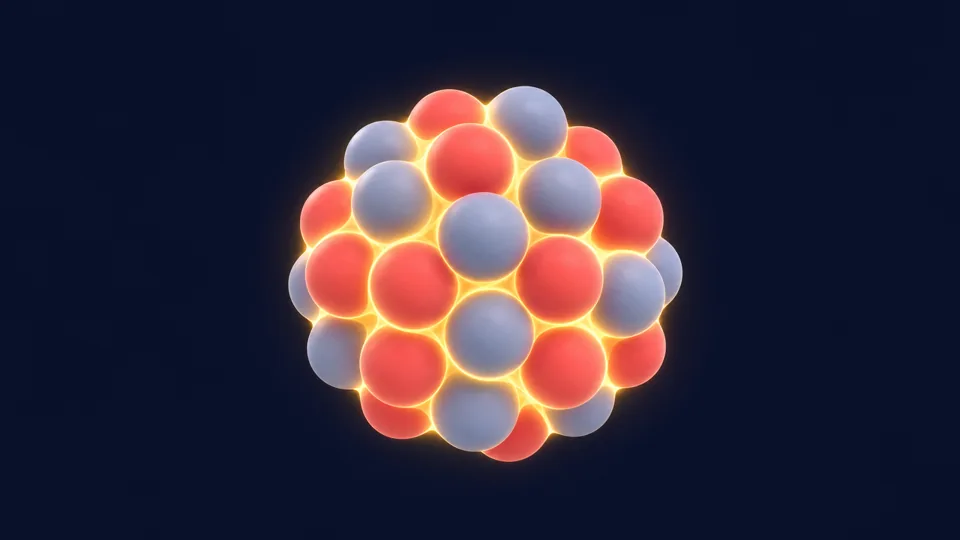
Red = protons (+ charge). Grey = neutrons (no charge). This is the whole nucleus of one atom.
The problem
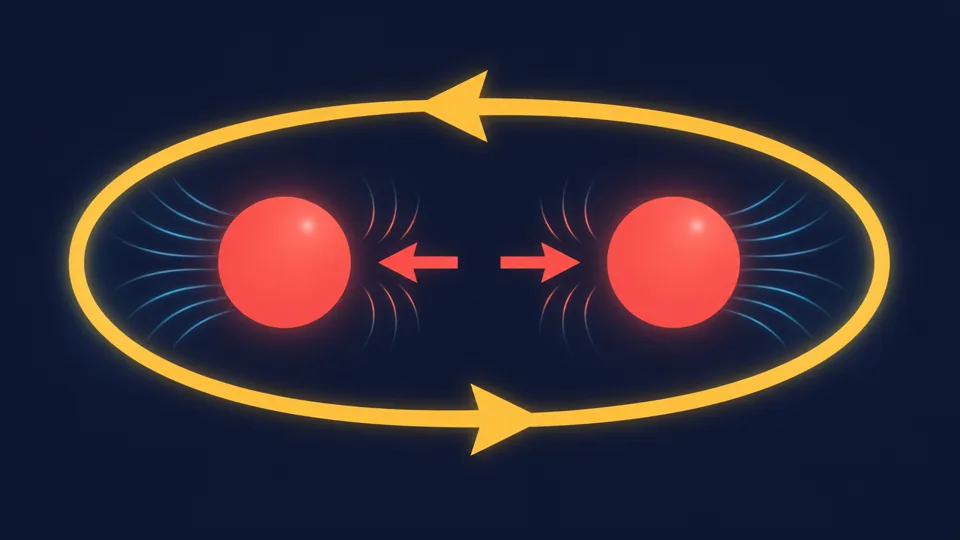
Every proton is positive, and like charges repel. Cram ninety-two of them into a space smaller than a trillionth of a centimeter and they should blow apart instantly.
The fix
The strong nuclear force pulls protons and neutrons together. It is far stronger than the electric repulsion, but it only reaches about one nucleon's width. Neutrons add strong force without adding any repulsion, which is why big nuclei need extra neutrons.
The strong force only pulls on next-door neighbors. Electric repulsion reaches across the whole nucleus.
When the balance breaks
Past bismuth-209 (83 protons), no combination of neutrons is enough. Every element heavier than that is radioactive. Some lighter nuclei are unstable too if their neutron count is off — carbon-14 has two more neutrons than stable carbon-12.
An unstable nucleus fixes itself by throwing something out. That is radioactive decay.
Misconception to drop right now: radioactive decay is not a chemical reaction. Chemistry happens in the electrons and never changes what element you have. Decay happens in the nucleus and changes the element itself. You cannot speed it up, slow it down, or stop it with heat, pressure, or a chemical.
Nuclear notation: every isotope has an address
Two numbers, stacked to the left of the symbol. Learn which is which once and the rest of the unit gets easy.
23892U
238 = mass number (A) — protons plus neutrons. The top one is the bigger one.
92 = atomic number (Z) — protons only. This is what makes it uranium.
How to get everything else
Protons = Z = the bottom number
Neutrons = A − Z = top minus bottom
Electrons = Z, if the atom is neutral
Nucleons (particles in the nucleus) = A
Same element, different isotope. Carbon-12, carbon-13, and carbon-14 all have 6 protons — they are all carbon. What changes is the neutron count, so what changes is A. 126C and 146C are the same element, and only one of them is radioactive.
Build one yourself
Pick an element, then add or remove neutrons. Watch what changes and what does not.
fewer neutronsmore neutrons
6
protons (Z)
6
neutrons (A − Z)
12
mass number (A)
6
electrons (neutral)
The number one mistake on this whole unit: reading the numbers upside down. If someone tells you 146C has 14 protons, they have swapped A and Z. The top number is always the bigger one, because protons plus neutrons is always at least as big as protons alone.
Three ways a nucleus throws something out
Alpha: a chunk of four leaves. Beta: a fast electron shoots out. Gamma: pure energy, nothing material leaves.
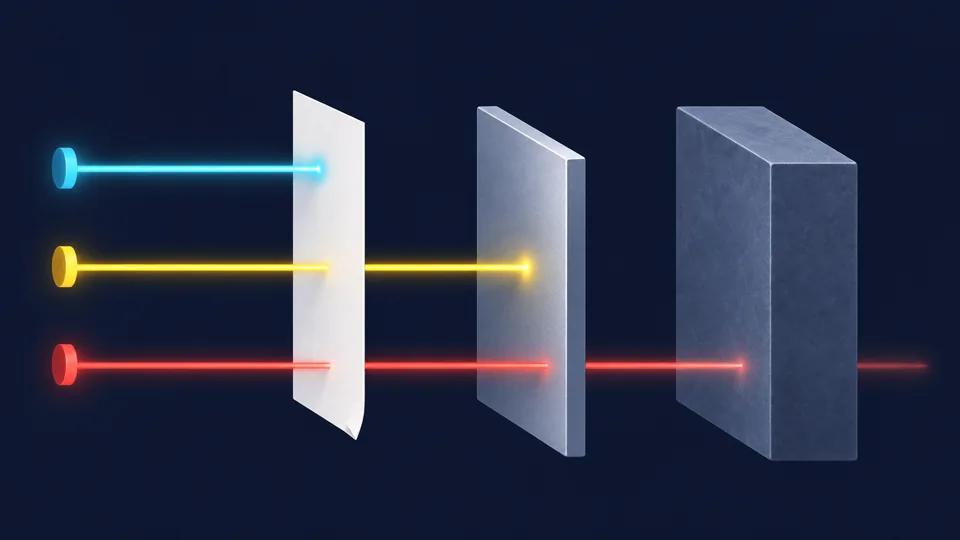
Top beam stopped by paper (alpha). Middle stopped by the aluminum sheet (beta). Bottom drives through the lead block (gamma).
42He
Alpha α
What it is: a helium nucleus — 2 protons + 2 neutrons, stuck together
Charge: +2 · Mass: heavy (4 u)
Stopped by: a sheet of paper, or your skin
Nucleus change:A drops by 4, Z drops by 2
New element? Yes — it moves two spots left on the periodic table
0−1e
Beta β
What it is: a fast electron — a neutron turns into a proton and kicks the electron out
Charge: −1 · Mass: almost nothing (0 u)
Stopped by: a few millimeters of aluminum
Nucleus change:A stays the same, Z goes UP by 1
New element? Yes — one spot to the right
00γ
Gamma γ
What it is: a burst of high-energy electromagnetic wave. Not a particle at all
Charge: 0 · Mass: 0
Stopped by: thick lead or concrete — and even then only partly
Nucleus change:A stays, Z stays. It only sheds energy
New element? No. Same element, calmer nucleus
The trade-off worth noticing. Alpha is the easiest to block and the hardest to ignore if it gets inside you — it is big and slow, so it dumps all its energy in one small place. Gamma passes straight through most of your body without interacting at all. "Most penetrating" and "most dangerous" are not the same question, and it depends entirely on whether the source is outside you or inside you.
Three things students say that are not true: (1) "Irradiated food is radioactive." No — gamma rays pass through and leave nothing behind, the same way light leaves your room when you flip the switch. (2) "Radiation is contagious." No — you cannot catch it from a person who had an X-ray. (3) "Any radiation at all will kill you." You are being hit by background radiation right now, from the ground, from space, and from the potassium inside your own body.
You are slightly radioactive
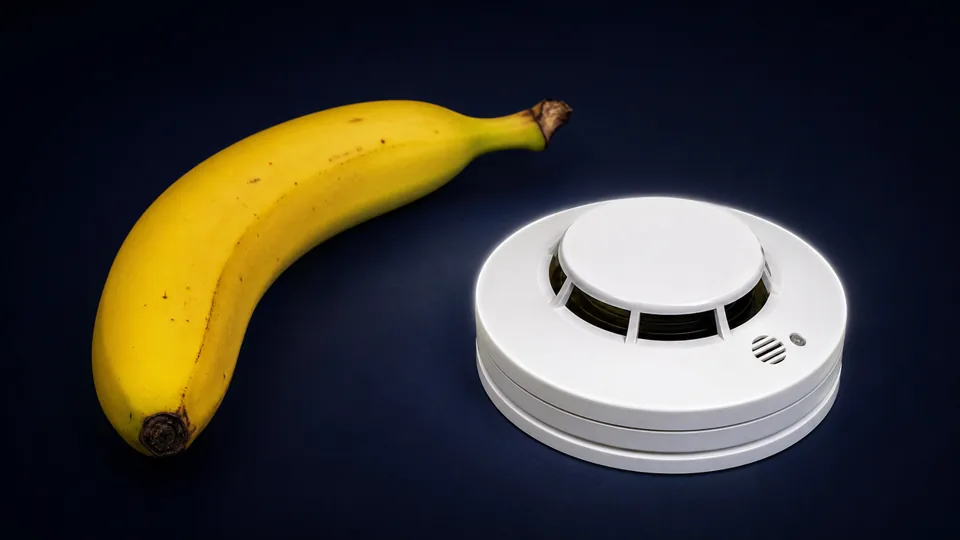
Bananas are rich in potassium, and a tiny fraction of all potassium on Earth is potassium-40, which is radioactive. So is the potassium in your muscles. So is the concrete in the building, the granite in a countertop, and the air in a basement.
Physicists joke about the "banana equivalent dose" for exactly this reason: the honest question is never "is there radiation?" It is always how much, of what kind, and for how long.
The Decay Lab
Pick a real unstable isotope, fire a decay, and watch the nucleus change. The equation writes itself underneath, and the balance check shows you both sums.
Parent:
Choose a decay above.
Balancing a nuclear equation
A nuclear equation is balanced when two things are true. That is the whole rule.
1. The mass numbers balance
Add up every top number on the left. Add up every top number on the right. They must match.
2. The atomic numbers balance
Add up every bottom number on the left. Add up every bottom number on the right. They must match too.
Worked example. Radium-226 emits an alpha particle.
22688Ra → ??? + 42He
Mass: 226 = ? + 4, so the daughter is 222. Atomic: 88 = ? + 2, so the daughter is 86. Element 86 is radon, so the answer is 22286Rn. You did not need to memorise anything — you subtracted twice and looked up 86.
Watch out for beta. Everyone expects the atomic number to go down, because something left the nucleus. In beta decay it goes up. The beta particle carries a charge of −1, so to keep the bottom row balanced the daughter has to be one higher: 6 = 7 + (−1). A neutron became a proton, and the nucleus gained a proton without gaining any mass.
A decay chain: uranium-238 becoming lead
One decay usually is not enough. U-238 goes through fourteen steps before it finally lands on something stable. Click any step.
Click a nucleus in the chain above.
Why it stops at lead-206. Every step sheds protons or rebalances neutrons, and the chain keeps going until it reaches a nucleus the strong force can actually hold together. Lead-206 is stable, so the chain ends. Every uranium atom that has ever decayed on Earth has taken this road, which is why uranium ore always has lead mixed into it.
One-minute videos
Simple Science, in about a minute each. Needs wifi.
Nuclear decay (SPS4.b)Fission & fusion (SPS4.a)
Next up: Half-Life puts a clock on all of this, and Fission & Fusion covers the two ways a nucleus changes that are not decay.
How are you feeling about this today?
Nothing here is graded. Switch levels any time.
Answered 0Streak 0No-hint 0
Coach
Speed round · Alpha, beta, or gamma
Sixty seconds. Press 1, 2, or 3, or click.
Score 0Best 0Time 60
Press Start.
Printable worksheets
Student page first, answer key on the next page. Shuffle to pull a fresh set.
A periodic table is needed for Levels 2 and 3, because students have to turn an atomic number back into an element symbol. The Periodic Table Explorer works on a Chromebook with the wifi off if you do not have paper copies.
Standard and targets
Georgia SPS4 — Obtain, evaluate, and communicate information to explain the changes in nuclear structure as a result of fission, fusion and radioactive decay.
This page covers the radioactive decay portion, plus the nuclear notation that SPS4.a and SPS4.b both depend on. The element breakdown never says "balance a nuclear equation" out loud, but students cannot explain a change in nuclear structure without a way to write the structure down, and the released items lean on it heavily. Teach this page first.
Target 1: the strong force, why heavy nuclei are unstable, decay is nuclear not chemical.
Target 2: A, Z, and finding protons / neutrons / electrons from a symbol.
Target 3: alpha, beta, gamma by mass, charge, penetration, and effect on A and Z.
Target 4: balancing both rows of a nuclear equation; solving for a missing piece in any position.
How the levels differ
Level 1 · Coach
Two-choice. Read A and Z off a symbol, count neutrons, match a radiation type to one property. The coach names which number to look at before they answer.
Level 2 · Guided
Four-choice. Parent + decay type → daughter. Missing particle in an equation. What happens to Z. Two hint layers, and wrong answers get diagnosed rather than marked.
Level 3 · Challenge
Equations run backwards, decay type identified from parent and daughter alone, gamma's no-change trick, two-step chains, and items where the missing piece is the parent rather than the daughter.
Misconceptions this page argues with by name
A and Z swapped. The single most common error. Every wrong answer that swaps them says so explicitly, and the builder in the Learn tab keeps both labelled.
"Beta decay lowers the atomic number." Intuitive and wrong. Handled with the charge bookkeeping, not just the rule.
"Gamma changes the element." It changes neither number. Level 3 includes items where the correct answer is that nothing changed.
"Irradiated food is radioactive" / "radiation is contagious" / "any dose is lethal." All three are addressed in the Learn tab with the banana as the anchor, so the argument lands before they hit the nuclear energy page.
"Decay is a chemical reaction." Called out at the top: chemistry is electrons, decay is the nucleus.
Classroom notes
Open with the banana. Hold one up, tell them it is radioactive, let the room react, then explain potassium-40. It buys you the whole rest of the unit because they stop treating "radiation" as a horror-movie word.
Project the Decay Lab and fire alpha three times in a row off the same parent without saying anything. Ask what pattern they see in the numbers before you ever give them the rule.
The beta surprise is worth staging. Ask the class to predict what happens to the atomic number before you fire it. Most will say it goes down. Let them be wrong out loud, then show the charge bookkeeping.
Walk the U-238 chain as a class and ask why it does not just emit fifty-six alphas in a row. The answer — the neutron-to-proton ratio keeps going wrong, so it has to alternate — is a genuinely good discussion.
Pair with the periodic table. Students need to convert Z back to a symbol constantly on this page. If they are shaky on that, run the Periodic Table Explorer first.
Nothing is collected: no names, no codes. Students can practice as long as they like and the numbers are freshly generated every time.