 Tobin
Everything for this unit
Start the unit

Civil Rights Lab: farms to cities, the vote, the schools & the movement
Nine hands-on parts built on real census counts, court records and photographs from 1939 to 1967. Every number on this page comes from a federal or state record, and its source is printed under it. The practice parts make new questions each time.
From the farm to the city
In 1940 most Georgia farm work was done by hand and by mules. Then came tractors, cotton pickers, fertilizer and weed killers. Pick a set of numbers, tap a bar or a dot to read it, and watch what one change did to the next.
The old way and the new, in photographs
Two mayors build modern Atlanta
William B. Hartsfield and Ivan Allen Jr. ran Atlanta for most of the years from 1937 to 1970. Both built the city while deciding what to do about segregation. Read both cards, then sort the facts.
Sort it: Hartsfield or Allen?
Atlanta grows, on the ground and in the air
The white primary, the county unit system and “three governors”
For decades the Democratic primary was the election that mattered in Georgia, and only white citizens could vote in it. Follow how that ended, try the county unit rule yourself, then check three men’s accounts of January 1947.
A. From one voter to a governor’s race: put it in order
B. Try the county unit rule
Five made-up counties. Drag each slider to set the share of voters who pick Candidate A. Whoever wins a county’s popular vote takes all of its unit votes.
C. The real 1946 primary
D. Three governors: check the accounts
In January 1947 three men claimed the governor’s office. Read each claim, then sort the cards with the four consistency steps: what all three agree on, where they differ, and what settled it.
Brown v. Board, and how Georgia’s leaders answered it
In 1954 the U.S. Supreme Court ruled that segregated public schools broke the Fourteenth Amendment. Georgia’s leaders opposed the ruling and wrote that opposition into law. Read the source, then trace what Georgia did until 1961.
A. Read the source
B. Georgia’s response, 1954–1961: put it in order
C. The 1956 state flag, in words
D. The Sibley Commission’s two reports
E. How fast did schools change?
Two leaders and two groups
Martin Luther King Jr. and John Lewis both made Atlanta their base, and so did the two groups they led, SCLC and SNCC. Read the cards, then match each fact to the person or group.
Match it: King, Lewis, SCLC or SNCC?
A note on sources: Dr. King’s speeches and writings are still under copyright, so this page tells you what he said in its own words instead of printing his.
The Albany Movement and the March on Washington
Two events, a year apart. In Albany, in southwest Georgia, a whole city was the target. In Washington, D.C., a crowd at the Lincoln Memorial pushed for a national law. Look at the photographs, then weigh two accounts of Albany.
A. Albany, 1962: what the photographs record
B. Was Albany a failure? Two accounts
C. The March on Washington, 28 August 1963
The 1964 Civil Rights Act: who resisted it, and Lester Maddox’s part
The Act turned on one question: may the owner of a business that serves the public choose whom to serve? Congress, the Supreme Court and a restaurant owner in Atlanta all answered it in 1964. Each position below is stated the way the people who held it argued it.
A. The law itself
B. The votes in Congress
C. Three Georgians who resisted, and the answer the law’s supporters gave
D. Who argued it?
E. From the Pickrick to the governor’s office: put it in order
Source Detective: who decides about Georgia’s schools?
Civil rights timeline builder
Six events from 1944 to 1967, drawn at random from the unit. Put them in order, check, and see them land on a timeline drawn to scale. Press New set for six more.
Drawn to scale, 1944 to 1970. Dots appear after you check your order.
Endless practice
New questions every time. Turn skills on or off to focus, and watch your streak.
Words you’ll own
Tap a card to see what it means, with the Spanish word underneath.
Review Quest for this unit
The paid, game-style review that maps every student’s weak spots and tells you exactly how each one did. Everything else on this page is free.

Post-WWII & Civil Rights — Review Quest
Game-style test review: a scouting mission maps what each student already knows, then skill zones teach, drill and check every SS8H10 and SS8H11 element, with vocabulary flashcards. A reward code tells you exactly how each student did.
Videos
The videos chosen for this unit's class slides, each with something to watch for and two questions for after. They open on YouTube.

Two mayors who changed Atlanta
Watch for: Watch for ONE thing each mayor built, and ONE thing each did about segregation.
- Hartsfield called Atlanta “the city too busy to hate.” What was he arguing?
- How did Atlanta’s growth change the rest of Georgia?
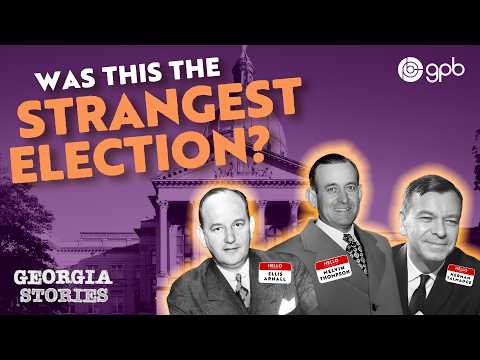
When Georgia had three governors
Watch for: Watch for each man’s CLAIM to the office — and what finally settled it.
- Herman Talmadge was not on the ballot. How did his father’s backers still get his name counted?
- Why did the county unit system matter to the result?

Brown v. Board — why didn’t Georgia follow it?
Watch for: Watch for the OPTIONS Georgia’s leaders tried, and the one they finally chose.
- What forced Georgia to choose in January 1961?
- Why did the Sibley Commission hold hearings all over the state?

Was the Albany Movement a success?
Watch for: Watch for ONE reason to call Albany a failure, and ONE reason to call it a success.
- Why did Pritchett’s plan keep Albany out of the national news?
- Is “success” a fact you can check, or a judgment?

Lester Maddox and the battle over desegregation
Watch for: Watch for what Maddox ARGUED, and what he DID — at the Pickrick and as governor.
- State Maddox’s argument in one sentence, the way he would have put it.
- How did a restaurant owner become governor three years later?
Free test review
The print unit
The complete unit for teachers is on TPT.