
Tobin Science logoTobinScience
6th Grade Math · 6.PAR.7

One-Step Equations & Inequalities

What makes an equation true, solving one-step equations with a balance, writing equations from stories, writing and graphing inequalities on a number line, and two variables that change together, with models you can move, worked examples and practice where you type the answer. Everything on this page is free.

One-step equations & inequalities: true or false, solving with a balance, story equations, inequalities on a number line & two variables ↓
Fraction & Decimal OperationsIntegers, Opposites & Absolute ValueRatios, Rates & Unit RatesPercents & Measurement ConversionsExpressions, Exponents, GCF & LCMOne-Step Equations & InequalitiesThe Coordinate PlaneArea, Surface Area & VolumeData & Statistics
On this page

Everything for this unit

One-step equations and inequalities · 6.PAR.7

One-Step Equations & Inequalities

Test values on a balance, then solve equations by undoing what was done to the variable. Turn stories into equations and graph inequalities. The practice questions never run out.

Start here

What you are learning

6.PAR.7. Write and solve one-step equations and inequalities as mathematical models to explain authentic, realistic situations.
6.PAR.7.1. Solve one-step equations and inequalities involving variables when values for the variables are given. Determine whether an equation and inequality involving a variable is true or false for a given value of the variable.
6.PAR.7.2. Write one-step equations and inequalities to represent and solve problems; explain that a variable can represent an unknown number or any number in a specified set.
6.PAR.7.3. Solve problems by writing and solving equations of the form x + p = q, px = q and x/p = q for cases in which p, q and x are all nonnegative rational numbers.
6.PAR.7.4. Recognize and generate inequalities of the form x > c, x ≥ c, x ≤ c, or x < c to explain situations that have infinitely many solutions; represent solutions of such inequalities on a number line.
6.EE.C.9 (bonus, Common Core). Use variables to represent two quantities in a real-world problem that change in relationship to one another; write an equation to express one quantity, thought of as the dependent variable, in terms of the other quantity, thought of as the independent variable. Analyze the relationship between the dependent and independent variables using graphs and tables, and relate these to the equation.

Learning targets

  • Decide if a value is a solution of an equation or an inequality by substituting it
  • Solve one-step equations by doing the inverse operation to both sides
  • Write an equation from a story, with a bar model to help
  • Write and graph inequalities, and explain why they have many solutions
  • Tell which variable depends on the other, and show it in a table and a graph (bonus)

Success criteria

I will be successful when I can:

  • substitute the value and check if both sides are equal
  • name what was done to the variable before I undo it
  • do the same thing to both sides of the equation
  • check my solution by putting it back into the equation
  • use a closed circle for ≥ and ≤, and an open circle for > and <
  • say what my letter stands for when I write an equation from a story
1A solution makes it true

Substitute a value for the variable. If both sides are equal, it is a solution.

2Keep the balance

An equation is like a level balance. Whatever you do to one side, do to the other side.

3Undo it

Adding and subtracting undo each other. So do multiplying and dividing.

4Many solutions

x > 3 is true for 3.5, 4, 10 and every number greater than 3. A graph shows them all.

5One depends on the other

If you earn $3 a dog, your pay depends on the dogs you walk: y = 3x.

x + 7 = 15. What is x? Your brain solved it before you finished reading. This page teaches you to write down what your brain just did. Then it still works when the numbers get harder.
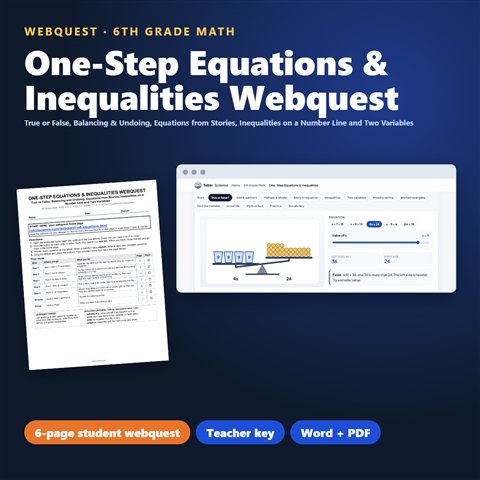
Part 1 · 6.PAR.7.1 · Substitution

What makes an equation true?

An equation says two amounts are equal. A solution is a value of the variable that makes it true. Pick an equation. Then move the slider to try a value. The balance is level only when both sides are equal.

Equation

Left side
Right side

Your turn: test the values

To substitute, put the number in place of the variable. Then see if both sides are equal.

Part 2 · 6.PAR.7.3 · Addition and subtraction

Keep the balance

An equation is like a balance. Whatever you do to one side, do to the other side. The cup hides x pennies. Pick a move and watch the balance. Your goal is to get the cup alone.

Balance

    Undo a subtraction

    A balance cannot show taking away very well, but a bar model can. The whole bar is the unknown. Inverse operations undo each other. Pick the move that undoes the subtraction.

      Your turn: addition and subtraction equations

      Undo what was done to the variable. Then check by substituting your answer.

      Part 3 · 6.PAR.7.3 · Multiplication and division

      Cups that share the pennies

      In 3x, the number 3 is the coefficient. 3x means 3 times x. Every cup hides the same number of pennies. Pick a move that shows what one cup holds.

      Balance

        Undo a division

        The tape is x, cut into equal parts. Change the number of parts and the size of each part. Watch how multiplying undoes dividing.

        Equation

        Your turn: multiplication and division equations

        Multiplying and dividing are inverse operations. A solution can be a decimal, like 2.5.

        Part 4 · 6.PAR.7.2 · Writing equations

        From a story to an equation

        A bar model shows how the numbers in a story fit together. Pick a story and look at its model. Then build the equation. Choose the operation and where the letter goes.

        1. The operation

        2. Where does the letter go?

        Your turn: write it, solve it, check it

        Find the unknown and pick a letter for it. Two parts that make a whole give an addition equation. Equal groups give a multiplication equation.

        Part 5 · 6.PAR.7.4 · Inequalities

        So many solutions

        An inequality compares two amounts with <, >, ≤ or ≥. It has many solutions, not just one. Pick the words. Then move the number and watch which test values light up.

        The words

        Inequality

        Graph it

        Tap the number line to place the circle. Pick an open circle or a closed circle. Then pick the way the arrow points.

        Your turn: write and read inequalities

        "At least" means ≥. "No more than" means ≤. To type them, use >= and <=.

        Part 6 · 6.EE.C.9 (bonus) · Two variables

        What does it depend on?

        Some stories have two variables that change together. The independent variable is the one you choose. The dependent variable changes because of it. Pick a story. Then move x and watch the table and the graph.

        Equation

        Fill in the table

        Use the rule to find each missing value.

        Plot the points

        Go right for x. Then go up for y.

        Your turn: two variables

        Ask: which amount depends on the other one?

        Part 7 · 6.PAR.7

        Equations and inequalities practice (it never runs out)

        Every question is made fresh, with new numbers each time. Pick a skill or leave it on Mixed. To type an equation, use the keys you have: x + 7 = 15, 4n = 10 or x/3 = 5. Leave out any $ sign. Type >= for ≥ and <= for ≤.

        Part 8

        Worked examples, step by step

        Open one step at a time. Try to guess the next step before you show it.

        Part 9

        Find the mistake

        Each solution has exactly one mistake. Tap the line where it first goes wrong.

        Part 10

        Equations and inequalities in real life

        Decide which idea explains each one, then pick it.

        Part 11

        Myth or fact?

        The most common mix-ups. Decide, then see the truth.

        Part 12

        Practice: the whole unit

        Questions from the whole unit: solutions, solving, story equations, inequalities and two variables. Press New set any time for different questions. Type >= for ≥ and <= for ≤.

        Sort it: what is the first move?

        Decide which inverse operation solves each equation. Then check your sort.

        Part 13

        Vocabulary

        Teachers Pay Teachers

        This unit on Teachers Pay Teachers

        Products for this unit from the Tobin Science store. They open on Teachers Pay Teachers in a new tab.

        Visit the whole Tobin Science store on Teachers Pay Teachers →

        Standards this unit matches

        Built for the Georgia Standards of Excellence. Teaching somewhere else? This unit also lines up with these standards.

        Georgia GSE6.PAR.7Common Core6.EE.B.5, 6.EE.B.6, 6.EE.B.7, 6.EE.B.8, 6.EE.C.9

        See every unit by state →

        ← Previous unitExpressions, Exponents, GCF & LCM