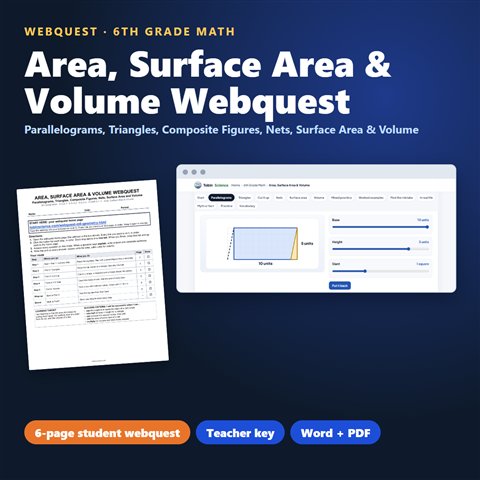
Area of parallelograms, triangles, trapezoids and composite figures, nets of prisms and pyramids, surface area from a net, and volume of boxes with fractional edges, with shapes you can cut, unfold and pack, worked examples and practice where you type the answer. Everything on this page is free.
Cut shapes apart and slide the pieces to see where every area rule comes from. Unfold solids into nets, then pack boxes with small cubes. The practice questions never run out.
Start here
What you are learning
6.GSR.5. Solve relevant problems involving area, surface area, and volume. 6.GSR.5.1. Explore area as a measurable attribute of triangles, quadrilaterals, and other polygons conceptually by composing or decomposing into rectangles, triangles, and other shapes. Find the area of these geometric figures to solve problems. 6.GSR.5.2. Given the net of three-dimensional figures with rectangular and triangular faces, determine the surface area of these figures. 6.GSR.5.3. Calculate the volume of right rectangular prisms with fractional edge lengths by applying the formula, V = (area of base) x (height).
Learning targets
Find the area of rectangles and parallelograms with base × height
Explain why a triangle is half of a parallelogram, and find its area
Cut trapezoids and composite figures into rectangles and triangles to find their area
Match a net to its solid and name its faces
Find surface area from a net by adding the area of every face
Find the volume of a box with half-unit edges, by packing cubes and with V = B × h
Success criteria
I will be successful when I can:
use the height that meets the base at a right angle, not a slanted side
take half of base × height for every triangle
draw dashed lines to cut a shape into pieces I know
count every face of a net, so none is left out
multiply the edges of a box for volume, never add them
label area in square units and volume in cubic units
1Built from a rectangle
Cut and slide a parallelogram, and it becomes a rectangle. So its area is base × height.
2A triangle is half
Two copies of a triangle make a parallelogram. So a triangle is ½ × base × height.
3Cut it up
Any shape with straight sides can be cut into rectangles and triangles. Add the pieces.
4Unfold it
A net shows every face of a solid. Surface area is all those faces added together.
5Fill it
Volume counts the cubes that fill a box. V = B × h, where B is the area of the base.
A triangle is half a rectangle that somebody cut along the diagonal. Every area rule on this page grows out of that one idea. Cut, slide and fill, and you will see why each rule works.
Part 1 · 6.GSR.5.1 · Rectangles and parallelograms
Cut and slide
Area is the number of square units that cover a shape. A parallelogram has two pairs of parallel sides. Change the base, the height and the slant. Then press Cut and slide and watch it turn into a rectangle.
Area = base × height
Your turn: rectangles and parallelograms
Use the height that meets the base at a right angle. Never use the slanted side.
Part 2 · 6.GSR.5.1 · Triangles
Half a parallelogram
Press Show the copy. Two copies of a triangle make a parallelogram, so the triangle has half its area. Move the top corner. Watch where the height falls: inside, on a side or outside.
Area = ½ × base × height
Your turn: triangles
Multiply base × height. Then take half.
Part 3 · 6.GSR.5.1 · Trapezoids and composite figures
Decompose, then add
A composite figure is made of simpler shapes. To decompose it, cut it into shapes you know. Pick a shape and a way to cut it. Then find the area of each piece and the total.
How will you cut it?
Your turn: trapezoids and composite figures
Cut the shape into rectangles and triangles. Add the pieces, or subtract a missing piece.
Part 4 · 6.GSR.5.2 · Nets of prisms and pyramids
Unfold the solid
A net is a flat pattern that folds up into a solid. It has one shape for each face. Pick a solid. Compare it with its net and count the faces.
Show on the net
Squares
Other rectangles
Triangles
All faces
Count the faces
Look at the net. Count each kind of face. Then count them all.
Your turn: nets
A prism has two matching bases. A pyramid has one base and triangles that meet at a point.
Part 5 · 6.GSR.5.2 · Surface area from nets
Every face, then add
The surface area of a solid is the total area of all its faces. Pick a solid and change its size. The list gives each face's measures. Find the area of every face, then add them.
Your turn: surface area
Unfold the solid in your head. Find every face. A box has three pairs of matching faces.
Part 6 · 6.GSR.5.3 · Volume with fractional edges
Pack it with small cubes
Volume is the number of cubic units that fill a solid. This box is packed with cubes that have ½-inch edges. Eight of them fill one cubic inch. Change the edges and compare the count with V = B × h.
Small cubes
Volume
Your turn: volume
B is the area of the base. Multiply it by the height: V = B × h.
Part 7 · 6.GSR.5
Area, surface area and volume practice (it never runs out)
Every question is made fresh, with new numbers each time. Pick a skill or leave it on Mixed. Type only the number. The unit is beside the box. Type a half like 7 1/2 or 7.5.
Part 8
Worked examples, step by step
Open one step at a time. Try to guess the next step before you show it.
Part 9
Find the mistake
Each solution has exactly one mistake. Tap the line where it first goes wrong.
Part 10
Area, surface area and volume in real life
Decide which idea explains each one, then pick it.
Part 11
Myth or fact?
The most common mix-ups. Decide, then see the truth.
Part 12
Practice: the whole unit
Questions from the whole unit: area, nets, surface area and volume. Press New set any time for different questions. Type only the number.
Sort it: area, surface area or volume?
Decide what each job measures. Then check your sort.
Part 13
Vocabulary
Teachers Pay Teachers
This unit on Teachers Pay Teachers
Products for this unit from the Tobin Science store. They open on Teachers Pay Teachers in a new tab.
 Tobin