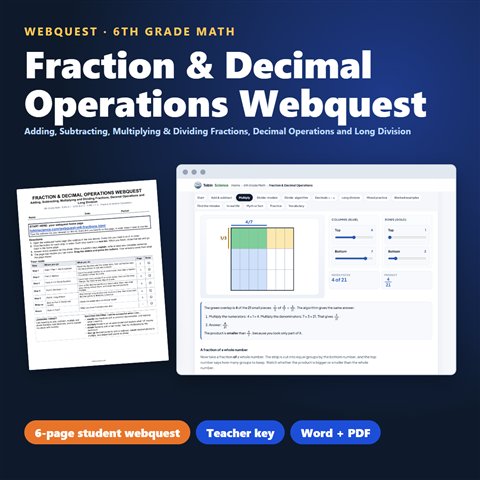
Adding and subtracting fractions and mixed numbers, multiplying with the area model, dividing fractions with models and with the reciprocal, decimal operations and long division, with models you can move, worked examples and practice where you type the answer. Everything on this page is free.
Cut fraction bars into equal pieces to add and subtract. Build products on an area model. Count how many scoops fit with a bar model, then run a keep, change, flip machine to divide fractions. Line up decimal points on a place-value chart and step through long division one move at a time. The practice questions never run out.
Start here
What you are learning
6.NR.1. Solve relevant, mathematical problems involving operations with whole numbers, fractions, and decimal numbers. 6.NR.1.1. Fluently add and subtract any combination of fractions to solve problems. 6.NR.1.2. Multiply and divide any combination of whole numbers, fractions, and mixed numbers using a student-selected strategy. Interpret products and quotients of fractions and solve word problems. 6.NR.1.3. Perform operations with multi-digit decimal numbers fluently using models and student-selected strategies.
Learning targets
Add and subtract fractions and mixed numbers with a common denominator, and regroup when I need to
Multiply fractions and mixed numbers with an area model and with the algorithm, and explain what "of" means
Divide fractions with models first, then by multiplying by the reciprocal
Interpret a quotient in a word problem: how many groups, or how much in each group
Add, subtract, multiply and divide decimals, and estimate to check where the decimal point goes
Success criteria
I will be successful when I can:
rewrite two fractions with a common denominator before I add or subtract them
regroup 1 whole when the first fraction is too small to subtract from
rewrite a mixed number as an improper fraction before I multiply or divide
count how many groups of the divisor fit, with a bar model or with common denominators
flip only the divisor, and check a quotient by multiplying back
line up the decimal points to add or subtract, and count the decimal places to multiply
estimate first on every decimal problem and compare my answer with the estimate
1Same-size pieces
You can add or subtract fractions only when the pieces are the same size, so find a common denominator first.
2"Of" means multiply
1/2 of 6 is 1/2 × 6. Multiplying by a fraction less than 1 takes part of a number, so the product is smaller.
3How many groups fit?
Division asks how many groups of the divisor fit in the dividend. A bar model shows it before any rule does.
4Keep, change, flip
To divide by a fraction, multiply by its reciprocal. Flip only the divisor, never the dividend.
5Where the point goes
Line up the points to add or subtract, count the decimal places to multiply, move both points to divide by a decimal. Estimate first, every time.
A recipe needs 12 cup of sugar, and the only scoop you can find holds 18 cup. How many scoops do you need? Your brain is already dividing fractions. In Part 3 you will see the answer on a bar model. By the end of this page you will be able to show your work for any fraction or decimal problem.
Part 1 · 6.NR.1.1 · Adding and subtracting fractions
Fraction bars: make the pieces the same size
Build two numbers with the sliders: a whole number, a top (numerator) and a bottom (denominator). Every bar is one whole, and all the bars use the same scale. Pieces of different sizes cannot be added, so press Cut into equal pieces and watch both numbers get a common denominator. Then read the steps, and see when you have to regroup.
Operation
Denominators to choose from
First number
Second number
Common denominator
Answer
Your turn: add and subtract
Estimate first. Find a common denominator, regroup if you need to, and write the answer in simplest form.
Part 2 · 6.NR.1.2 · Multiplying fractions
The area model: a fraction of a fraction
The square is one whole. The first fraction shades columns blue and the second shades rows gold. The green overlap is the product, because "of" means multiply: 25 of 34 is 25 × 34. Change the four sliders, count the green pieces, then check the count with the algorithm: multiply the tops, multiply the bottoms.
Columns (blue)
Rows (gold)
Green pieces
Product
A fraction of a whole number
Now take a fraction of a whole number. The strip is cut into equal groups by the bottom number, and the top number says how many groups to keep. Watch whether the product is bigger or smaller than the whole number.
Product
Your turn: multiply
Rewrite a mixed number as an improper fraction first. Multiply straight across, then simplify.
Part 3 · 6.NR.1.2 · Dividing fractions with models
How many scoops fit? Division with a bar model
Here is the recipe from the start of the page: 12 cup of sugar and a scoop that holds 18 cup. Division asks how many groups fit, so 12 ÷ 18 asks how many 18-cup scoops fill 12 cup. Count the scoops on the bar. Then pick another scoop and slide the amount: the amounts on the slider are the ones that a whole number of scoops can fill.
The scoop holds
Scoops
The division
Your turn: divide with a model
Use the drawing when there is one. With a common denominator, divide the numerators. If the divisor does not fit a whole number of times, the quotient is a fraction or a mixed number.
Part 4 · 6.NR.1.2 · Dividing fractions with the algorithm
The keep, change, flip machine
To divide by a fraction, multiply by its reciprocal. Pick a dividend and a divisor, then press Next step to run the machine one step at a time. It makes mixed numbers improper, keeps the first fraction, changes ÷ to × and flips only the divisor. Then it multiplies, simplifies, and checks by multiplying back.
Reciprocal of the divisor
Quotient
Your turn: what does the quotient mean?
In a word problem, ask: am I finding how many groups fit, or how much is in one group? Then keep, change, flip.
Part 5 · 6.NR.1.3 · Adding, subtracting and multiplying decimals
Line up the decimal points
Pick two numbers and an operation. To add or subtract, line up the decimal points, so tenths sit under tenths and hundredths under hundredths, and write zeros to fill empty places. Try Line up the last digits to see what goes wrong. Always estimate first.
Estimate first
Answer
Multiply decimals: count the decimal places
To multiply, you do not line up the points. Multiply as if the numbers were whole numbers, then count the decimal places in both factors. The product gets that many decimal places. The estimate tells you if the point is in a sensible place.
Estimate first
Product
Your turn: decimals and money
Estimate, then work it out. Your answer should be close to your estimate.
Part 6 · 6.NR.1.3 · Dividing decimals
Long division, one step at a time
Bonus: long division of whole numbers (the Common Core standard 6.NS.B.2). Long division divides one place at a time: divide, multiply, subtract, bring down, and repeat. Press the Next button and say the next move before you see it. The amount left at the end is the remainder, and it is always less than the divisor.
The problem
Dividing by a decimal: move both points
To divide by a decimal, move its point to the right until the divisor is a whole number. Then move the point in the dividend the same number of places. Both numbers are multiplied by the same 10 or 100, so the quotient does not change. Pick a problem and move the points one place at a time.
Your turn: divide
To divide by a whole number, bring the point straight up. To divide by a decimal, move both points first. Check by multiplying back.
Part 7 · 6.NR.1
Fractions and decimals practice (it never runs out)
Every question is made fresh, with new numbers each time. Pick a skill or leave it on Mixed. Write fractions in simplest form, and estimate first on every decimal question.
Part 8
Worked examples, step by step
Open one step at a time. Try to guess the next step before you show it.
Part 9
Find the mistake
Each solution has exactly one mistake. Tap the line where it first goes wrong. The lines after it only carry that mistake along.
Part 10
Fractions and decimals in real life
Decide which idea explains each one, then pick it.
Part 11
Myth or fact?
The most common mix-ups. Decide, then see the truth.
Part 12
Practice: the whole unit
Ten questions at a time from the whole unit: fractions, mixed numbers, decimals and long division. Press New set any time for different questions.
Sort it: bigger, smaller or the same?
Compare the answer with the FIRST number, without working it out. Multiplying by a number less than 1 or dividing by a number more than 1 gives a smaller answer. Decide for each one, then check your sort.
Part 13
Vocabulary
Teachers Pay Teachers
This unit on Teachers Pay Teachers
Products for this unit from the Tobin Science store. They open on Teachers Pay Teachers in a new tab.
 Tobin