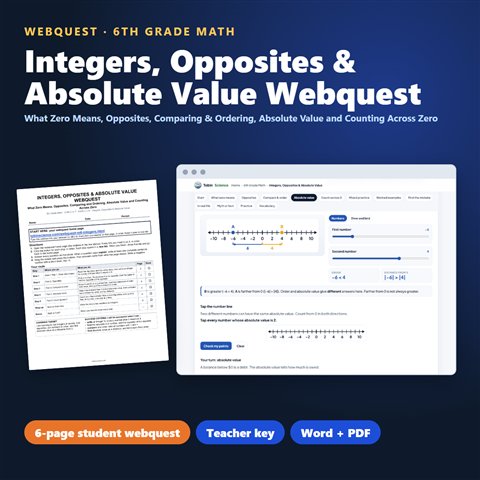
Positive and negative numbers and what zero means in a story, opposites on the number line, comparing and ordering rational numbers, and absolute value as distance from zero, with number lines you can tap, worked examples and practice where you type the answer. Everything on this page is free.
Use number lines and thermometers to see what zero means in a story. Flip numbers to their opposites, put them in order, and measure absolute value as a distance from 0. The practice questions never run out.
Start here
What you are learning
6.NR.3. Solve a variety of problems involving whole numbers and their opposites; model rational numbers on a number line to describe problems presented in relevant, mathematical situations. 6.NR.3.1. Identify and compare integers and explain the meaning of zero based on multiple authentic situations. 6.NR.3.2. Order and plot integers on a number line and use distance from zero to discover the connection between integers and their opposites. 6.NR.3.3. Recognize and explain that opposite signs of integers indicate locations on opposite sides of zero on the number line; recognize and explain that the opposite of the opposite of a number is the number itself. 6.NR.3.4. Write, interpret, and explain statements of order for rational numbers in authentic, mathematical situations. Compare rational numbers, including integers, using equality and inequality symbols. 6.NR.3.5. Explain the absolute value of a rational number as its distance from zero on the number line; interpret absolute value as distance for a positive or negative quantity in a relevant situation. 6.NR.3.6. Distinguish comparisons of absolute value from statements about order.
Learning targets
Write an integer for a story, and explain what 0 means in that story
Plot and read integers and other rational numbers on number lines and thermometers
Find the opposite of a number, and explain why the opposite of the opposite is the number itself
Compare and order rational numbers, and write statements of order with < and >
Find absolute value as a distance from 0, and tell it apart from order
Success criteria
I will be successful when I can:
decide what 0 means in the story before I choose a sign
count the tick marks from 0 to plot or read a point
place opposites the same distance from 0, on opposite sides
read the number line from left to right to put numbers in order
check that every absolute value I write is 0 or more
ask "greater, or farther from 0?" before I compare two numbers
1Zero is the starting point
In every story, 0 means something: 0 degrees, sea level, no money in or out. Above or gained is positive. Below or lost is negative.
2Opposites mirror each other
A number and its opposite are the same distance from 0, on opposite sides. The opposite of the opposite is the number itself.
3Farther right is greater
On a number line, the number farther to the right is greater. Of two negatives, the one closer to 0 is greater: −3 > −8.
4Absolute value is distance
The absolute value of a number is its distance from 0, so it is never negative: |−7| = 7.
5Order is not distance
Farther from 0 is not always greater. −10 < 6, but −10 is farther from 0.
One valley floor sits 282 feet below sea level. A thermometer there once read 134 degrees. One number is below zero and one is above. But zero means something different in each story. In Part 1 you will decide what 0 means in a story. By the end of this page you can order any rational numbers and measure how far each one is from 0.
Part 1 · 6.NR.3.1 · Integers and the meaning of zero
What does zero mean in the story?
An integer is a whole number or its negative, like −5, 0 or 8. A positive number is greater than 0. A negative number is less than 0, and it has a minus sign, like −5. In every story, first decide what 0 means. Pick a story and a direction, then move the slider.
Story
Direction
The integer
Zero means
Tap the thermometer
A thermometer is a vertical number line. Numbers above 0 are positive, and numbers below 0 are negative. Tap the tick mark for each temperature.
Your turn: write the integer
Decide what 0 means. Then decide if the number is positive or negative. To type a minus sign, use the hyphen key (-).
Part 2 · 6.NR.3.2 · 6.NR.3.3 · Opposites
Flip a number across zero
Opposites are the same distance from 0, on opposite sides. Pick a number with the slider. Press Flip across 0 to see its opposite. Then flip again to find the opposite of the opposite.
Its opposite
Distance from 0
Tap the number line
Count the tick marks from 0. Left of 0 is negative, and right of 0 is positive.
Your turn: opposites
Same distance from 0, other side. The opposite of 0 is 0. A minus sign in front of a number means "the opposite of," so −(−5) means the opposite of −5.
Part 3 · 6.NR.3.4 · Comparing and ordering
Farther right is greater
A rational number is a number you can write as a fraction, like −2 or 1.5. Move A and B on the number line. The one farther to the right is greater. The symbol < means "is less than" and > means "is greater than." A statement of order uses one of them to compare two numbers. Read it both ways, then pick a story.
Story
Statement of order
The same fact
Put them in order
Tap the cards from least to greatest. Picture each number on the number line first. The number farthest to the left is the least.
Your turn: compare and order
Of two negative numbers, the one closer to 0 is greater. Every negative number is less than every positive number.
Part 4 · 6.NR.3.5 · 6.NR.3.6 · Absolute value
Absolute value is distance from zero
The absolute value of a number is its distance from 0. We write it with two bars: |−7| = 7. Move the slider and watch the bracket from 0. A distance is never negative.
Absolute value
Order or distance?
Order tells which number is greater. Absolute value tells which number is farther from 0. Move both numbers. Find a pair where the answers are different.
Order
Distance from 0
Tap the number line
Two different numbers can have the same absolute value. Count from 0 in both directions.
Your turn: absolute value
A balance below $0 is a debt. The absolute value tells how much is owed.
Your turn: order or absolute value?
Read each question carefully. "Greater" and "higher" ask about order. "Farther from 0" and "bigger debt" ask about absolute value.
Part 5 · 6.NR.3.5 · Counting on the thermometer
How many degrees warmer?
The morning was below zero and noon was above zero. To find how much warmer it got, count on the thermometer. Count up to 0 first, then count on. Set the two temperatures and press the button one step at a time.
Up to 0
From 0 on
In all
Your turn: count across zero
Count from the first temperature to 0. Then count from 0 to the second temperature. The two counts together are the answer.
Part 6 · 6.NR.3
Integers and absolute value practice (it never runs out)
Every question is made fresh, with new numbers each time. Pick a skill or leave it on Mixed. To type a negative answer, use the hyphen key (-) as the minus sign.
Part 7
Worked examples, step by step
Open one step at a time. Try to guess the next step before you show it.
Part 8
Find the mistake
Each solution has exactly one mistake. Tap the line where it first goes wrong. The lines after it only carry that mistake along.
Part 9
Integers and absolute value in real life
Decide which idea explains each one, then pick it.
Part 10
Myth or fact?
The most common mix-ups. Decide, then see the truth.
Part 11
Practice: the whole unit
Ten questions at a time from the whole unit: integers in stories, opposites, order and absolute value. Press New set any time for different questions.
Sort it: positive, negative or zero?
Decide what 0 means in each story first. Then decide if the number is positive, negative or zero, and check your sort.
Part 12
Vocabulary
Teachers Pay Teachers
This unit on Teachers Pay Teachers
Products for this unit from the Tobin Science store. They open on Teachers Pay Teachers in a new tab.
 Tobin