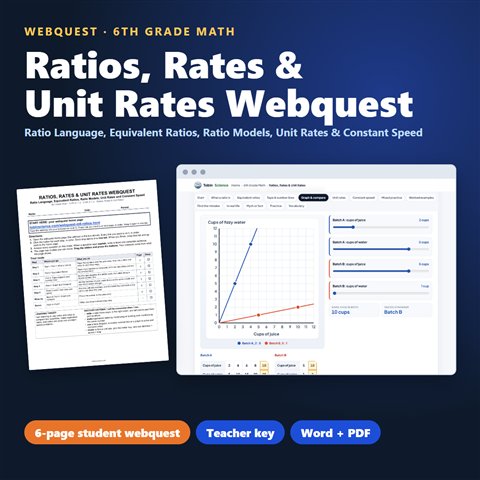
Ratios and ratio language, equivalent ratios, tape diagrams and double number lines, ratio tables and graphs, unit rates, unit prices and constant speed, with models you can move, worked examples and practice where you type the answer. Everything on this page is free.
Mix a drink and write its ratio three ways. Make more batches, fill in ratio tables, and build tape diagrams and double number lines. Plot a ratio table and find out which juice is stronger. Then run a unit rate machine, pick the better buy, and send a bus and a van down the road at constant speeds. The practice questions never run out.
Start here
What you are learning
6.NR.4. Solve a variety of contextual problems involving ratios, unit rates, equivalent ratios, percentages, and conversions within measurement systems using proportional reasoning. 6.NR.4.1. Explain the concept of a ratio, represent ratios, and use ratio language to describe a relationship between two quantities. 6.NR.4.2. Make tables of equivalent ratios relating quantities with whole-number measurements, find missing values in the tables, and plot the pairs of values on the coordinate plane. Use tables to compare ratios. 6.NR.4.3. Solve problems involving proportions using a variety of student-selected strategies. 6.NR.4.4. Describe the concept of rates and unit rate in the context of a ratio relationship. 6.NR.4.5. Solve unit rate problems including those involving unit pricing and constant speed.
Learning targets
Explain what a ratio is and use ratio language to describe how two quantities are related
Make tables of equivalent ratios, find missing values and plot the pairs on the coordinate plane
Solve ratio problems with a strategy you choose: a ratio table, a tape diagram or a double number line
Describe a rate and a unit rate, and find a unit rate by dividing
Solve unit rate problems about unit prices and constant speed
Success criteria
I will be successful when I can:
write a ratio three ways with the numbers in the right order
tell a part-to-part ratio from a part-to-whole ratio
multiply or divide both numbers of a ratio by the same number to make an equivalent ratio
find the value of one box in a tape diagram and use it to answer the question
compare two ratios by making one quantity the same in both
divide to find a unit rate and label it with the word "per"
use distance = speed × time to find how far, how long or how fast
1A ratio compares
A ratio compares two quantities, and the order of the numbers matters.
2Multiply both, same mix
Multiply or divide both numbers by the same number and the ratio stays equivalent.
3Four pictures, one ratio
A table, a tape diagram, a double number line and a graph can all show the same ratio.
4Per means for each one
A unit rate is the amount for exactly 1 unit. Divide to find it.
5Speed is a unit rate
At a constant speed, distance = speed × time.
A juice recipe uses 1 cup of juice for every 3 cups of fizzy water. A friend makes a bigger batch with 3 cups of juice and 5 cups of fizzy water and says it tastes the same. Does it? To decide, you have to think in ratios: how much of one thing there is for every amount of the other. By Part 4 of this page you will be able to prove the answer.
Part 1 · 6.NR.4.1 · Ratio language
Mix the juice: what a ratio tells you
A ratio compares two quantities. This drink is made of cups of juice and cups of fizzy water. Change the cups, then choose which two quantities to compare. Watch how the ratio is written three ways, and notice that the quantity you name first gets the first number.
Compare
In words
With a colon
As a fraction
Your turn: write the ratio
Read which quantity is named first. A new question is made every time.
Part 2 · 6.NR.4.2 · Equivalent ratios
Make more batches: equivalent ratios
One batch of lemonade uses some scoops of mix and some cups of water. Make more batches and both numbers are multiplied by the same number. The new ratio is an equivalent ratio: bigger numbers, the same taste. Set one batch, then change the number of batches and watch the ratio table.
Mix to water now
Simplest form
The ratio table for this lemonade
Every column is an equivalent ratio. The gold column is the number of batches you chose.
Your turn: fill in a ratio table
Find a column where you know both numbers. Ask what it was multiplied by, then do the same thing to the other number.
Check yourself
Part 3 · 6.NR.4.3 · Two ratio models
Draw it: tape diagrams and double number lines
A tape diagram shows a ratio as equal boxes. Every box holds the same amount, so one box is the total divided by the number of boxes. Build a sticker pack below: choose the boxes for stars and hearts, then choose how many stickers go in each box.
Stars to hearts
Stickers in all
The double number line
A double number line lines up two quantities. Both lines start at 0, and equal jumps on the top line match equal jumps on the bottom line. Set the size of one jump on each line, then slide along the line. Each pair that lines up is an equivalent ratio.
Nuts to cereal here
Your turn: solve it with a model
Count the boxes, find one box, then answer. Some questions use a double number line.
Part 4 · 6.NR.4.2 · Plot and compare
Which juice is stronger? Graph it and compare
Each column of a ratio table is an ordered pair you can plot. The points of equivalent ratios line up on a straight line through (0, 0). Set two batches of juice. To compare them, make the juice the same in both, then look at the water: less water with the same juice tastes stronger.
Same juice in both
Tastes stronger
Your turn: plot a ratio table
The first quantity goes on the x-axis and the second on the y-axis. Go right for the first number, then up for the second. Tap the grid to place each point.
Check yourself: compare the ratios
Part 5 · 6.NR.4.4 · 6.NR.4.5 · Rates and unit rates
The unit rate machine: how much for one?
A rate is a ratio of two quantities with different units, like dollars and pounds. A unit rate is the amount for exactly 1 unit. The word per means "for each one." To find a unit rate, divide the first quantity by the second. Change the pounds of apples and the total cost, and watch the price for 1 pound.
The cost moves in steps that divide evenly by the pounds. When you change the pounds, the cost may move to the nearest step.
The rate
The unit rate
Which pack is the better buy?
The unit price is the cost of one item. The better buy is the pack with the lower unit price, even when its price tag is bigger. Change the size and the price of each pack of juice boxes.
Each price moves in steps that divide evenly by the number of juice boxes. When you change the size of a pack, its price may move to the nearest step.
Your turn: find the unit rate
Divide to find the amount for one. Type money like 0.75 or 2.50.
Part 6 · 6.NR.4.5 · Constant speed
On the road: distance, time and speed
At a constant speed you go the same distance every hour. Speed is a unit rate, like 50 miles per hour. Set a speed for the bus and for the van, then run the trip or slide the time. To find a distance, multiply the speed by the time.
Bus has gone
Van has gone
The bus on a double number line
Every hour adds the same number of miles. Read a distance above its time, or a time below its distance.
Your turn: how far, how long, how fast?
Distance = speed × time. To find the time, divide the distance by the speed. To find the speed, divide the distance by the time.
Part 7 · 6.NR.4
Ratios and rates practice (it never runs out)
Every question is made fresh, with new numbers each time. Pick a skill or leave it on Mixed. Type a ratio like 3 : 5 and money like 0.75.
Part 8
Worked examples, step by step
Open one step at a time. Try to guess the next step before you show it.
Part 9
Find the mistake
Each solution has exactly one mistake. Tap the line where it first goes wrong. The lines after it only carry that mistake along.
Part 10
Ratios and rates in real life
Decide which idea explains each one, then pick it.
Part 11
Myth or fact?
The most common mix-ups. Decide, then see the truth.
Part 12
Practice: the whole unit
Ten questions at a time from every part of 6.NR.4. Press New set any time for different questions.
Sort it: part-to-part or part-to-whole?
Some ratios compare one part with another part. Others compare one part with the whole group. Decide for each ratio, then check your sort.
Part 13
Vocabulary
Teachers Pay Teachers
This unit on Teachers Pay Teachers
Products for this unit from the Tobin Science store. They open on Teachers Pay Teachers in a new tab.
 Tobin