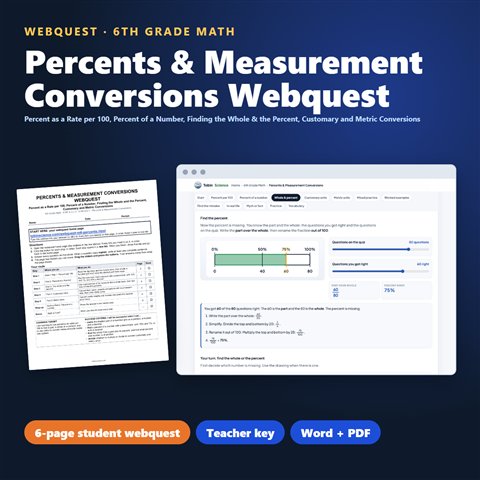
Percent as a rate per 100, percents as fractions and decimals, finding a percent of a number, finding the whole and the percent, and converting customary and metric units with ratios, with models you can move, worked examples and practice where you type the answer. Everything on this page is free.
Shade a hundred grid and name the shaded part as a percent, a fraction and a decimal. Run a sale rack to find a percent of a number three ways. Use a percent bar to find a missing whole or a missing percent. Then convert feet, cups and pounds with conversion ratios, and watch the decimal point move in metric conversions. The practice questions never run out.
Start here
What you are learning
6.NR.4. Solve a variety of contextual problems involving ratios, unit rates, equivalent ratios, percentages, and conversions within measurement systems using proportional reasoning. 6.NR.4.6. Calculate a percent of a quantity as a rate per 100 and solve everyday problems given a percent. 6.NR.4.7. Use ratios to convert within measurement systems (customary and metric) to solve authentic problems that exist in everyday life.
Learning targets
Explain a percent as a rate per 100 and write it as a fraction and as a decimal
Find a percent of a number with a benchmark percent, the 10% and 1% strategy, or a decimal
Find the whole when you know a part and its percent
Find what percent one number is of another
Convert measurements inside the customary system and inside the metric system by using ratios
Success criteria
I will be successful when I can:
name the shaded part of a hundred grid as a percent, a fraction and a decimal
rename a fraction out of 100 to write it as a percent
find 10% by dividing by 10 and 1% by dividing by 100, then build other percents from them
draw a percent bar to find the whole from a part
write the part over the whole and rename it out of 100 to find a percent
decide whether to multiply or divide when I convert units, and explain why
move the decimal point the right way when I multiply or divide by 10, 100 or 1,000
1Percent means per 100
A percent is a rate per 100. 30% means 30 out of 100.
2The whole is 100%
To find a percent of a number, the number is the whole, or 100%.
310% and 1% build the rest
Divide by 10 to find 10% and by 100 to find 1%. Other percents are built from them.
4Part, whole, percent
Every percent problem has a part, a whole and a percent. Know two and you can find the third.
5Big to small: multiply
To convert a big unit to a small unit, multiply. To convert a small unit to a big unit, divide.
One store sign says 25% off a $48 hoodie. The sign next door says $12 off the same hoodie. Which deal is better? To decide, you have to know what a percent of a number is: how much of the whole it stands for. By Part 2 of this page you will be able to prove the answer.
Part 1 · 6.NR.4.6 · Percent as a rate per 100
Shade the grid: percent means per 100
A percent is a rate per 100. This grid has 100 equal squares, so each square is 1% and each column is 10%. Slide to shade squares, or tap a square on the grid. Watch the shaded part get three names at once: a percent, a fraction and a decimal.
Benchmark percents
Percent
Fraction
Decimal
Your turn: shade it
This grid gives you no names. Rename the amount out of 100 in your head, then shade that many squares.
Check yourself: three names for one amount
Read what the question asks for: a percent, a decimal or a fraction. A new question is made every time.
Part 2 · 6.NR.4.6 · Percent of a number
The sale rack: find a percent of a number
One sign says 25% off a $48 hoodie. The sign next door says $12 off. Which deal is better? To find a percent of a number, the number is the whole, or 100%. Change the price and the percent. Watch the percent bar, then read the strategy steps: a benchmark, the 10% and 1% strategy, and the decimal check.
Percents are on top. Dollars are below. The whole bar is the whole price, or 100%.
Benchmark percents
The discount
Sale price
Your turn: find the part
Name the whole. Pick a strategy. Then check: is your answer reasonable? 50% is half.
Part 3 · 6.NR.4.6 · Part, whole and percent
Which number is missing? Find the whole, find the percent
Every percent problem has three numbers: the part, the whole and the percent. Here the whole is missing. You know how many pages you have read and what percent of the book that is. The percent bar has 10 equal boxes, and each box is 10% of the book. Change the two sliders and watch how one box leads to the whole book.
The pages move in steps that split evenly into the boxes. When you change the percent, the pages may move to the nearest step.
One box (10%)
The whole book (100%)
Find the percent
Now the percent is missing. You know the part and the whole: the questions you got right and the questions on the quiz. Write the part over the whole, then rename the fraction out of 100.
Part over whole
Percent right
Your turn: find the whole or the percent
First decide which number is missing. Use the drawing when there is one.
Part 4 · 6.NR.4.7 · Customary conversions
Feet, cups and pounds: convert with a ratio
To convert a measurement is to write it in a different unit. A conversion factor is a ratio of equal amounts, like 12 inches for every 1 foot. Pick two units, pick a direction and slide the amount. Going from a big unit to a small unit, you need more of them, so you multiply. Going from a small unit to a big unit, you need fewer, so you divide.
Units
Direction
Conversion ratio
It is the same as
A chain of ratios: gallons to cups
Some conversions take more than one step. Capacity goes gallons, quarts, pints, cups. Slide the gallons and follow the chain, one ratio at a time.
Your turn: fill in a conversion table
Every column is the same ratio. Decide whether to multiply or divide, then fill in each box.
Check yourself
Part 5 · 6.NR.4.7 · Metric conversions
Powers of ten: watch the decimal point move
The metric system is built on powers of ten, so every conversion multiplies or divides by 10, 100 or 1,000. Pick two units, pick a direction and slide the amount. The digits stay in order. Only the decimal point moves: to the right when you multiply and to the left when you divide.
The grey ring is where the decimal point starts. The gold dot is where it ends.
Units
Direction
What to do
It is the same as
Your turn: fill in a metric table
Count the zeros in the conversion fact. That is how many places the decimal point moves.
Check yourself
Part 6 · 6.NR.4
Percents and conversions practice (it never runs out)
Every question is made fresh, with new numbers each time. Pick a skill or leave it on Mixed. Read what the question asks for: a percent, a decimal, a fraction or an amount.
Part 7
Worked examples, step by step
Open one step at a time. Try to guess the next step before you show it.
Part 8
Find the mistake
Each solution has exactly one mistake. Tap the line where it first goes wrong. The lines after it only carry that mistake along.
Part 9
Percents and conversions in real life
Decide which idea explains each one, then pick it.
Part 10
Myth or fact?
The most common mix-ups. Decide, then see the truth.
Part 11
Practice: the whole unit
Ten questions at a time from the whole unit: percents and measurement conversions. Press New set any time for different questions.
Sort it: multiply or divide?
To convert a big unit to a small unit, you multiply. To convert a small unit to a big unit, you divide. Decide for each conversion, then check your sort.
Part 12
Vocabulary
Teachers Pay Teachers
This unit on Teachers Pay Teachers
Products for this unit from the Tobin Science store. They open on Teachers Pay Teachers in a new tab.
 Tobin