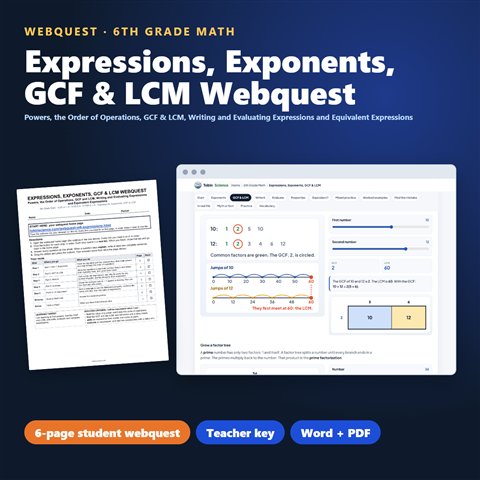
Exponents and the order of operations, greatest common factor and least common multiple, writing and evaluating expressions, the properties of operations and equivalent expressions, with models you can move, worked examples and practice where you type the answer. Everything on this page is free.
Build powers, find the GCF and LCM, and turn words into expressions. Then evaluate, simplify and test expressions with models you control. The practice questions never run out.
Start here
What you are learning
6.PAR.6. Identify, write, evaluate, and interpret numerical and algebraic expressions as mathematical models to explain relevant situations. 6.PAR.6.1. Write and evaluate numerical expressions involving rational bases and whole-number exponents. 6.PAR.6.2. Determine greatest common factors and least common multiples using a variety of strategies to make sense of applicable problems. 6.PAR.6.3. Write and read expressions that represent operations with numbers and variables in realistic situations. 6.PAR.6.4. Evaluate expressions when given values for the variables, including expressions that arise in everyday situations. 6.PAR.6.5. Apply the properties of operations to identify and generate equivalent expressions.
Learning targets
Find the value of a power with a whole, fraction or decimal base, and use the order of operations
Find the GCF and the LCM of two numbers, and tell which one a story needs
Write and read expressions, and name their terms, coefficients and constants
Evaluate expressions and formulas for given values
Use the properties of operations to write, factor and test equivalent expressions
Success criteria
I will be successful when I can:
write out a power as repeated multiplication before I find its value
do parentheses, then exponents, then multiply and divide, then add and subtract
ask "equal groups or matching up?" to choose the GCF or the LCM
start with the variable when the words say "less than"
put parentheses around a number I substitute, like 3(5), not 35
test two expressions with a value of the variable before I call them equivalent
1An exponent counts factors
2⁵ means 2 × 2 × 2 × 2 × 2 = 32, not 2 × 5. The exponent tells how many times to use the base.
2Order matters
Parentheses come first, then exponents. Multiply and divide next. Add and subtract last.
3GCF shares, LCM matches
The GCF splits things into equal groups. The LCM finds when two counts first match.
4A variable stands for a number
If each pack holds 8 stickers, then 8p works for any number of packs p. Replace p with a number to evaluate it.
5Equivalent means always equal
2(x + 3) and 2x + 6 match for every x. One value that does not match proves two expressions are not equivalent.
Hot dogs come in packs of 6. Buns come in packs of 8. What is the smallest number of each you can buy so nothing is left over? That number has a name, and so does the trick for finding it. In Part 2 you will watch the two counts meet. By the end of this page you can write, evaluate and rewrite expressions too.
Part 1 · 6.PAR.6.1 · Exponents
Build a power
An exponent tells how many times to use the base as a factor. In 2⁵, the base is 2 and the exponent is 5. Pick a base. Then move the slider and watch the product grow or shrink.
Base
Written out
Value
What comes next?
The order of operations is the order for doing math. First parentheses. Next exponents. Then multiply and divide, left to right. Last, add and subtract, left to right. Tap the step that comes next.
Your turn: powers and the order of operations
Work it out on paper first. Then type the number.
Part 2 · 6.PAR.6.2 · GCF and LCM
Where do two numbers meet?
A factor divides a number with no remainder. The greatest common factor (GCF) is the largest factor two numbers share. A multiple is the number times 1, 2, 3 and so on. The least common multiple (LCM) is the smallest multiple they share. Hot dogs come in packs of 6 and buns in packs of 8. Start there, then try other numbers.
GCF
LCM
Grow a factor tree
A prime number has only two factors: 1 and itself. A factor tree splits a number until every branch ends in a prime. The primes multiply back to the number. That product is the prime factorization.
Sort it: GCF or LCM?
Sharing into equal groups uses the GCF. Finding when things match up uses the LCM. Decide for each story, then check.
Your turn: GCF and LCM
List the factors or count by the bigger number. Then type your answer.
Part 3 · 6.PAR.6.3 · Writing expressions
Turn words into symbols
A variable is a letter that stands for a number. An expression has numbers, variables and operation signs, but no equal sign. Pick the words and a number. Watch where the n goes.
The words
Words
Expression
Packs of stickers
Each pack holds 8 stickers. Change the number of packs. The expression 8p works for every number of packs.
Tap the part
A term is one part of an expression. Plus signs separate the terms. The coefficient is the number multiplied by a variable. The constant is a term with no variable.
Your turn: write and read expressions
"Less than" flips the order. A number next to a letter means multiply.
Part 4 · 6.PAR.6.4 · Evaluating
Toothpick squares
To evaluate an expression, replace each variable with its value. Then use the order of operations. Make a row of toothpick squares. Check the rule 3n + 1 against the drawing.
Toothpicks
Use a formula
Pick a formula. Then size the shape with the sliders.
Fill in the rule table
Put each n into the rule. Type each output.
Your turn: evaluate
Substitute first. Write 3(5), not 35. Then follow the order of operations.
Part 5 · 6.PAR.6.5 · Properties of operations
The distributive property
The distributive property says to multiply the number outside by each term inside. A rectangle shows why. Change the height and one part of the length.
Equivalent
Combine like terms
Like terms have the same variable part, like 4x and 2x. Constants are like terms too. Pick an expression, then combine the tiles.
Your turn: properties and simplifying
The commutative property changes the order. The associative property changes the grouping.
Part 6 · 6.PAR.6.5 · Is it equivalent?
Test it with a number
Equivalent expressions give the same value for every value of the variable. Pick a pair. Then move x and compare the values.
First
Second
Fill in the table
Put each x into each expression. Use the order of operations.
Your turn: factor, expand and test
To expand, multiply out the parentheses. To factor, put the GCF outside. Check a factored answer by expanding it.
Part 7 · 6.PAR.6
Expressions and exponents practice (it never runs out)
Every question is made fresh, with new numbers each time. Pick a skill or leave it on Mixed. To type an expression, use the keys you have: 4n + 7, or 3(x + 2).
Part 8
Worked examples, step by step
Open one step at a time. Try to guess the next step before you show it.
Part 9
Find the mistake
Each solution has exactly one mistake. Tap the line where it first goes wrong. The lines after it only carry that mistake along.
Part 10
Expressions and exponents in real life
Decide which idea explains each one, then pick it.
Part 11
Myth or fact?
The most common mix-ups. Decide, then see the truth.
Part 12
Practice: the whole unit
Ten questions at a time from the whole unit: exponents, GCF and LCM, writing, evaluating and equivalent expressions. Press New set any time for different questions. To type an expression, use the keys you have: y - 8, or 3(x + 2).
Sort it: equivalent to 4(x + 3)?
Decide if each expression always has the same value as 4(x + 3). Expand it, or test a value of x. Then check your sort.
Part 13
Vocabulary
Teachers Pay Teachers
This unit on Teachers Pay Teachers
Products for this unit from the Tobin Science store. They open on Teachers Pay Teachers in a new tab.
 Tobin