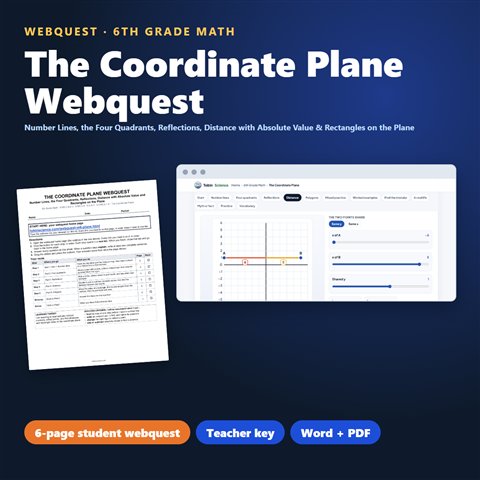
Fractions, decimals and negative numbers on number lines, plotting points in all four quadrants, reflections across the axes, distances found with absolute value, and rectangles on the plane, with grids you can tap, worked examples and practice where you type the answer. Everything on this page is free.
Read fractions and negatives on number lines that lie flat or stand up. Plot and flip points in all four quadrants. Then measure distances and build rectangles from their corners.
Start here
What you are learning
6.PAR.8. Graph rational numbers as points on the coordinate plane to represent and solve contextual, mathematical problems; draw polygons using the coordinates for their vertices and find the length of a side of a polygon. 6.PAR.8.1. Locate and position rational numbers on a horizontal or vertical number line; find and position pairs of integers and other rational numbers on a coordinate plane. 6.PAR.8.2. Show and explain that signs of numbers in ordered pairs indicate locations in quadrants of the coordinate plane and determine how two ordered pairs may differ based only on the signs. 6.PAR.8.3. Solve problems by graphing points in all four quadrants of the coordinate plane. Include use of coordinates and absolute value to find distances between points with the same x-coordinate or the same y-coordinate. 6.PAR.8.4. Draw polygons in the coordinate plane given coordinates for the vertices; use coordinates to find the length of a side joining points with the same x-coordinate or the same y-coordinate.
Learning targets
Place and read fractions, decimals and negative numbers on horizontal and vertical number lines
Plot and name points in all four quadrants with ordered pairs
Use the signs of a point to name its quadrant, and change a sign to reflect it across an axis
Find the distance between two points that share an x or a y, with absolute value
Draw polygons from their vertices, and find side lengths, perimeter and area of rectangles
Success criteria
I will be successful when I can:
find the size of one step before I read or plot a number
move right or left for the x-coordinate first, then up or down for the y-coordinate
name the quadrant from the signs, and say "no quadrant" for a point on an axis
change only one sign for a reflection across one axis
ask "same side or opposite sides?" before I add or subtract absolute values
check a distance by counting the units on the grid
1Find the step first
Count the spaces between two labels. Four spaces from 0 to 1 means each step is one fourth.
2x first, then y
In (x, y), x says how far right or left. y says how far up or down. The order matters.
3Signs name the quadrant
Quadrant I is (+, +), II is (−, +), III is (−, −) and IV is (+, −). A point on an axis is in no quadrant.
4A reflection changes a sign
Across the x-axis, the sign of y changes. Across the y-axis, the sign of x changes.
5Add or subtract absolute values
Opposite sides of an axis: add them. Same side: subtract the smaller from the larger. A distance is never negative.
A treasure map says: start at the well, go 4 blocks west and 3 blocks south. Mathematicians write that as (−4, −3). It works for every map ever drawn. In Part 2 you will plot that point yourself. By the end of this page you can measure the walk between any two spots on the map.
Part 1 · 6.PAR.8.1 · Number lines
Read the tick marks
A rational number can be written as a fraction, like −34 or 2.5. First find the size of one step between tick marks. Pick a step size. Then move point P and watch its name change.
Step size
As a fraction
As a decimal
A vertical number line
A thermometer is a number line that stands up. Positive numbers are above 0. Negative numbers are below 0. The higher number is always the greater one.
The story
Reading
Distance from 0
Your turn: place the number
Each step on this line is one fourth. Tap the tick mark for the number.
Your turn: set the thermometer
Each mark is half a degree. Tap the mark for the temperature.
Your turn: read the line
Find the step size first. Then type the number.
Part 2 · 6.PAR.8.1 · 6.PAR.8.2 · Plotting
Plot a point anywhere
The coordinate plane is two number lines that cross at 0. The ordered pair (x, y) names a point. The first number says how far right or left. The second says how far up or down. Move P with the sliders or the buttons.
Ordered pair
Signs
Where it is
The treasure map. "Start at the well. Go 4 blocks west and 3 blocks south." Put the well at the origin. West is left and south is down, so the treasure is at (−4, −3), in Quadrant III.
Your turn: plot the points
Tap the grid where two lines cross. Start at (0, 0) every time.
Your turn: name the point
The signs name the quadrant. A point on an axis is in no quadrant.
Part 3 · 6.PAR.8.2 · Reflections
Change a sign, flip the point
A reflection flips a point across an axis, like a mirror. Pick a mirror and a point. Predict where the point lands before you look. Then check which sign changed.
The mirror
P
P′ (the reflection)
P′ =
Your turn: plot the reflection
Point P is drawn. Tap where its reflection goes.
Your turn: reflections
Keep one coordinate. Change the sign of the other.
Part 4 · 6.PAR.8.3 · Distance
Add or subtract?
A and B share an x or a y, so they sit on one straight line. The absolute value of a number is its distance from 0. Move A and B. Before you see the distance, decide: add or subtract the absolute values?
The two points share
A
B
Absolute values
Sides of the axis
Distance
Your turn: find the distance
Opposite sides of the axis: add. Same side: subtract. Count on the grid to check.
Part 5 · 6.PAR.8.4 · Polygons
Build a rectangle
A polygon is a closed figure with straight sides. Each corner is a vertex. Move the four sides of rectangle ABCD. Find the side lengths from the coordinates. Then work out the perimeter and the area.
Your turn: plot the vertices
Plot each vertex. When they are right, the rectangle appears.
Your turn: sides, perimeter and area
Find each side with absolute value first. Perimeter adds all four sides. Area is length × width.
Part 6 · 6.PAR.8
The coordinate plane practice (it never runs out)
Every question is made fresh, with new numbers each time. Pick a skill or leave it on Mixed. Type an ordered pair like (-4, 3). Use the hyphen key (-) as the minus sign.
Part 7
Worked examples, step by step
Open one step at a time. Try to guess the next step before you show it.
Part 8
Find the mistake
Each solution has exactly one mistake. Tap the line where it first goes wrong. The lines after it only carry that mistake along.
Part 9
The coordinate plane in real life
Decide which idea explains each one, then pick it.
Part 10
Myth or fact?
The most common mix-ups. Decide, then see the truth.
Part 11
Practice: the whole unit
Ten questions at a time from the whole unit: number lines, plotting, quadrants, reflections, distances and polygons. Press New set any time for different questions. Type an ordered pair like (-4, 3). Use the hyphen key (-) as the minus sign.
Sort it: add or subtract?
Each pair of points shares an x or a y. To find the distance, do you add the absolute values or subtract them? Decide, then check your sort.
Part 12
Vocabulary
Teachers Pay Teachers
This unit on Teachers Pay Teachers
Products for this unit from the Tobin Science store. They open on Teachers Pay Teachers in a new tab.
 Tobin